Post: B2B Growth & Scalability: The AI Operations Imperative
Unlocking Enterprise Scalability: The Strategic Imperative of AI-Driven Operations for B2B Growth
In the relentless pursuit of growth, B2B companies often find themselves caught in a paradox: the more successful they become, the more intricate and time-consuming their operations seem to grow. Scaling isn’t merely about increasing revenue; it’s about building a resilient, efficient operational backbone that can support exponential demand without succumbing to the drag of manual processes and human error. This is precisely where the strategic integration of AI-driven operations moves from a technological novelty to a critical business imperative.
For decades, automation has been the silent engine of efficiency. Yet, traditional automation, while powerful, often operates within predefined rules, struggling with nuance, variability, and the unstructured data that defines much of modern business. Enter AI. By infusing operations with artificial intelligence, businesses gain the capacity to not only automate repetitive tasks but also to analyze, predict, and adapt in ways previously impossible. This isn’t about replacing human intelligence but augmenting it, allowing high-value employees to focus on strategic initiatives rather than getting mired in low-value, high-volume work.
Beyond Simple Automation: The Cognitive Shift
Consider the typical B2B sales cycle or the complex onboarding process for a new client. These pathways are riddled with data entry, document generation, communication flows, and decision points that, even when partially automated, still require significant human oversight. An AI-driven operational approach transcends these limitations. Imagine a system that not only backs up your CRM data but intelligently identifies inconsistencies, suggests proactive remediation, or even learns to categorize inbound leads with greater precision based on historical success metrics. This is the cognitive shift we champion at 4Spot Consulting: moving from task-based automation to outcome-driven operational intelligence.
The power of AI lies in its ability to process vast quantities of data, identify patterns, and make informed decisions. For B2B firms, this translates into capabilities like predictive maintenance for customer relationships, intelligent document processing that extracts key information from contracts or invoices, or even AI-powered assistants that streamline internal communications. The goal is to build a “single source of truth” for your data, making every operational decision more robust and data-backed. This eliminates the siloed information and fragmented processes that often plague scaling businesses, costing them significant time and resources.
Building an OpsMesh: Weaving AI into Your Business Fabric
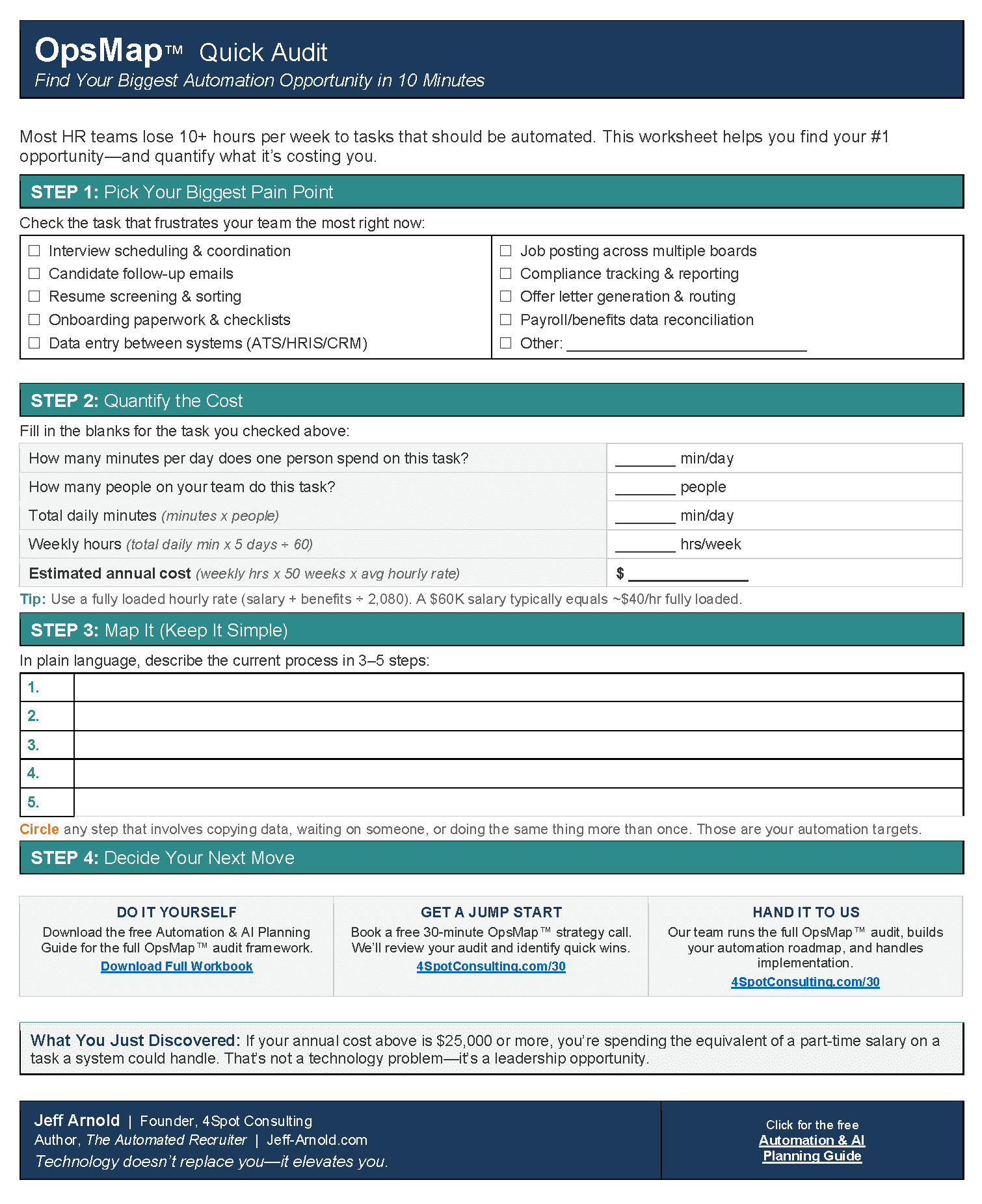
At 4Spot Consulting, our OpsMesh framework is designed precisely for this integration. We don’t just bolt on AI tools; we strategically weave them into your existing business fabric. This starts with an OpsMap™ diagnostic – a deep dive into your current operations to uncover every bottleneck, every redundant step, and every hidden opportunity for intelligent automation. We look for where human error is most prevalent and where valuable employee time is most wasted.
For instance, in HR and recruiting, the sheer volume of resumes, applications, and communications can overwhelm even the most dedicated teams. We’ve seen clients save over 150 hours per month by deploying AI to intelligently parse resumes, extract relevant skills, and even score candidates against job requirements, seamlessly integrating this data into their CRM like Keap. This isn’t just speed; it’s precision. It means the right candidates are identified faster, reducing time-to-hire and improving the quality of hires, directly impacting revenue potential.
The Real-World Impact: More Than Just Efficiency
The benefits extend far beyond mere efficiency gains. When AI handles the grunt work, your teams are liberated to innovate, strategize, and build stronger client relationships. This improves employee satisfaction, reduces churn in critical roles, and cultivates a culture of strategic thinking rather than reactive task management. It allows companies to scale not just in volume but in strategic depth. Your sales teams can spend more time selling, your HR teams more time developing talent, and your leadership more time shaping the future of the company.
Consider the challenge of maintaining accurate CRM data. A common pain point, particularly with systems like Keap or HighLevel, is the constant need for updates and backups to prevent data decay. AI can monitor data quality, flag discrepancies, and even initiate automated enrichment processes, ensuring your customer records are always pristine and actionable. This proactivity not only saves countless hours but also safeguards your most valuable asset: your customer relationships.
The Path Forward: Strategic, Intentional AI Integration
Integrating AI into your operations is not a one-size-fits-all solution. It requires a strategic, intentional approach that begins with understanding your unique business challenges and objectives. Our OpsBuild™ process focuses on implementing tailored solutions using best-in-class tools like Make.com, Keap, and specialized AI platforms, ensuring every automation directly supports a measurable business outcome. We prioritize solutions that deliver rapid ROI, whether it’s through cost reduction, revenue acceleration, or enhanced scalability.
The future of B2B growth is intrinsically linked to intelligent operations. By embracing AI, companies can move beyond simply doing more with less, to doing more with *smarter* systems. This isn’t about replacing the human element, but about empowering it, amplifying its impact, and freeing it to drive innovation. The time saved—often 25% or more of your day—isn’t just a number; it’s a strategic advantage that allows your business to outperform, outmaneuver, and outgrow the competition.
Ready to uncover automation opportunities that could save you 25% of your day? Book your OpsMap™ call today.
If you would like to read more, we recommend this article: The Automation Paradox: Why More Tech Doesn’t Always Mean More Efficiency


RELATED POST