

Post: What Is Intelligent Automation? AI-Powered Workflows for Small Business
Intelligent automation combines rules-based workflow automation with AI capabilities — natural language processing, predictive logic, and adaptive error handling — so complex, context-dependent tasks execute without human intervention. It is not a product you switch on. It is a practice with a required sequence: structured automation first, AI augmentation second. Skip that sequence and you get smarter chaos, not efficiency.
Definition (Expanded)
Intelligent automation sits at the intersection of two distinct capability layers. The first is workflow automation — deterministic, rules-based logic that connects applications, moves data, and executes predefined actions when specific triggers fire. The second is artificial intelligence — probabilistic reasoning that interprets unstructured inputs, predicts likely next steps, classifies data, and adjusts behavior based on context.
Neither layer is complete without the other in high-complexity environments. Pure rules-based automation breaks when inputs vary. Pure AI without a structured execution layer produces outputs that are difficult to audit, replicate, or trust at scale.
Intelligent automation is the deliberate architecture that connects both: a clean trigger-action pipeline that enforces data consistency, with AI reasoning applied at the decision points where variability is unavoidable.
Gartner defines intelligent automation as encompassing robotic process automation, machine learning, natural language processing, and process mining as a unified capability set — not as isolated tools deployed independently.
How Intelligent Automation Works
Intelligent automation operates through four sequential components. Understanding each one clarifies why sequence and data quality are non-negotiable.
1. Trigger and Data Capture
Every intelligent automation starts with a defined trigger — a form submission, a status change, an inbound email, a scheduled interval. The trigger captures structured or semi-structured data and passes it into the pipeline. Data quality at this stage determines the reliability of every downstream step, including any AI reasoning applied later. Inconsistent data at the trigger point is the single most common cause of intelligent automation failure in small business deployments.
2. Rules-Based Execution Layer
The structured automation layer applies deterministic logic: route this record to this destination, format this field, send this notification, update this status. This layer runs the same way every time for the same inputs. It is the quality gate for the entire workflow — catching formatting errors, routing mismatches, and missing fields before they contaminate downstream systems or any AI reasoning that follows.
3. AI Reasoning and Decision Support
Once clean, consistently formatted data flows through the rules-based layer, AI capabilities add value at decision points where variability is inherent. Natural language interfaces translate plain-English descriptions into executable workflow configurations. Predictive models surface the most likely next action based on historical patterns. Classification models route records — leads, tickets, candidates, invoices — to the correct downstream process without manual triage. This is the layer that scales judgment, not the layer that replaces process discipline.
4. Adaptive Feedback and Error Recovery
Mature intelligent automation includes a feedback loop: the system monitors its own execution, flags patterns that indicate data or logic problems, and — in more advanced implementations — suggests or applies corrective adjustments. This adaptive layer reduces the human overhead required to maintain complex workflows over time. Automation programs that include monitoring and exception-handling protocols sustain ROI significantly longer than those configured once and left unattended.
Expert Take
The most common deployment mistake is building the AI layer before the structured execution spine exists. When data feeding the workflow is inconsistent, the AI layer produces confident wrong outputs — and confident wrong outputs are harder to catch than obvious failures. Build the execution layer first. Verify it runs clean. Then add AI reasoning only where variability is genuinely unavoidable.
Why Intelligent Automation Matters for Small Business
Small businesses operate with constrained capacity. Every hour spent on repeatable, low-judgment work is an hour not spent on customer relationships, product development, or strategic decisions. McKinsey Global Institute research indicates automation of knowledge-work tasks frees 20–30% of worker time across a range of business functions. For a five-person operation, that is the equivalent of reclaiming one full-time role’s output without adding headcount.
The compounding effect matters as much as the initial time savings. When intelligent automation handles candidate routing, invoice exception flagging, lead scoring, and internal notifications consistently and accurately, error rates drop, rework decreases, and the team’s judgment capacity concentrates on work that actually requires it.
Error reduction — not just time savings — is the primary financial driver in knowledge-work automation. A single data-entry error in a payroll or offer-letter workflow triggers a compounding cost: correction cycles, compliance exposure, and eroded trust in the systems running the business. A structured data-handling layer catches that class of error before it reaches any downstream system or AI reasoning step.
For a real-world look at what correctly sequenced automation delivers at scale, the 103K annual labor hours Make automation case study shows the financial return when the execution spine is built before AI augmentation is layered in.
Key Components of Intelligent Automation
Six components define a complete intelligent automation architecture for small business:
- Process documentation. A written map of the trigger, inputs, decision points, outputs, and error conditions for the workflow being automated. Without this, no automation layer — intelligent or basic — produces consistent results.
- Trigger definition. The specific, observable event that starts the workflow. Ambiguous triggers produce inconsistent execution.
- Data standardization. Input fields formatted consistently before they enter the pipeline. This is the quality gate that makes AI reasoning reliable downstream.
- Rules-based execution logic. Deterministic routing, formatting, and notification steps that run identically for identical inputs.
- AI reasoning layer. Natural language interpretation, predictive suggestions, or classification applied at decision points where variability cannot be eliminated by rules alone.
- Monitoring and exception handling. A defined protocol for identifying when the automation produces unexpected outputs, who reviews it, and how the logic is updated.
Before building any of these components, the prior question is whether the process qualifies for automation at all. 10 real examples of why clean processes must come before any HR automation walks through what process-ready actually looks like in practice — and what gets built when it is not.
Related Terms
Intelligent automation is frequently confused with adjacent terms. These distinctions matter for deployment decisions:
- Workflow automation. The rules-based execution layer alone — triggers and actions without AI reasoning. The foundation, not the complete architecture.
- Robotic process automation (RPA). Software that mimics human UI interactions to automate desktop tasks. A subset of workflow automation, typically applied to legacy systems without APIs.
- Hyperautomation. A Gartner-coined term for the combination of RPA, AI, process mining, and low-code development to automate as many business processes as possible at enterprise scale. Intelligent automation is a practical starting point for SMBs on the path toward hyperautomation.
- AI-native automation. Systems built from the ground up on AI reasoning, without a separate rules-based layer. High capability ceiling, high failure risk when underlying data is inconsistent — which describes most small business environments.
- No-code automation. Workflow automation configured through visual interfaces rather than programming. The delivery mechanism for most small business intelligent automation implementations.
For small businesses evaluating where to start, the practical distinction is this: no-code workflow automation delivers the structured execution layer; AI features within those platforms deliver the reasoning layer. Both are required. 10 automations finally easy to build with Make AI — no developer required shows how the AI reasoning layer integrates into practical no-code workflow configurations without adding technical overhead.
Common Misconceptions
Four misconceptions consistently derail small business automation programs before they produce results.
Misconception 1: “AI automation replaces the need for structured workflows.”
AI augments structured workflows — it does not replace them. Natural language interfaces can generate a workflow configuration from a plain-English prompt, but if the data feeding that workflow is inconsistent, the generated workflow produces confident wrong outputs. The structured layer is the quality gate, not a legacy approach to be skipped.
Misconception 2: “Intelligent automation is only accessible to large enterprises.”
The barrier to entry has dropped substantially. No-code workflow platforms with integrated AI capabilities are accessible to businesses of any size. The constraint is process maturity, not company size or technical resources. A team of five with one well-documented, high-volume process can deploy intelligent automation and recover measurable ROI within a single quarter.
Misconception 3: “Once configured, intelligent automation runs itself indefinitely.”
Intelligent automation requires ongoing ownership. Applications change their APIs. Data formats drift. Business rules evolve. An automation configured to a process that no longer exists produces silent errors at scale. The monitoring and exception-handling component of the architecture exists precisely because maintenance is not optional — it is a recurring operational responsibility.
Misconception 4: “More AI features means better automation.”
Feature density is not a proxy for ROI. Research on automation program outcomes consistently identifies process selection and data quality — not platform sophistication — as the primary determinants of realized value. A simple, clean three-step workflow running reliably delivers more value than a complex AI-augmented workflow running on inconsistent data.
For a full catalog of the patterns that end SMB automation programs early, 11 common mistakes HR teams make automating internally covers what we see most frequently across client deployments — and what to do instead.
Intelligent Automation in HR and Recruiting: A Compliance Note
HR and recruiting workflows present the highest-value and highest-risk application of intelligent automation for small business. Interview scheduling, candidate routing, offer-letter generation, and onboarding task creation are strong candidates for the structured automation layer — and the time-to-fill acceleration from automating these steps has a direct financial return.
AI-assisted hiring decisions — scoring, ranking, or filtering candidates using AI reasoning — carry regulatory scrutiny. The EU AI Act classifies AI systems used in employment decisions as high-risk, requiring documented audit trails, human oversight, and bias assessment protocols. The structured automation layer is not just an efficiency tool in this context — it is the compliance infrastructure that makes AI-assisted HR decisions legally defensible.
The 13 essential questions for HR leaders before investing in automation includes the compliance due-diligence questions that apply when AI reasoning touches any part of the talent acquisition pipeline.
How to Assess Readiness for Intelligent Automation
Three criteria determine whether a process is ready for intelligent automation deployment:
- The process is documented and repeatable. If two people describe the process differently, it is not ready for automation. Document it until the description is consistent, then automate it.
- The data inputs are clean and consistently formatted. If the fields feeding the workflow contain free-text where structured data is required, fix the data collection step before building the automation layer.
- Success and failure are defined. If the team cannot articulate what a correct output looks like, they cannot configure an automation that produces one — and they cannot detect when it fails.
If all three criteria are met, the structured automation layer can be built and tested immediately. AI augmentation is appropriate once the structured layer runs clean for a defined period — typically 30 days of stable execution with a documented exception rate below an acceptable threshold.
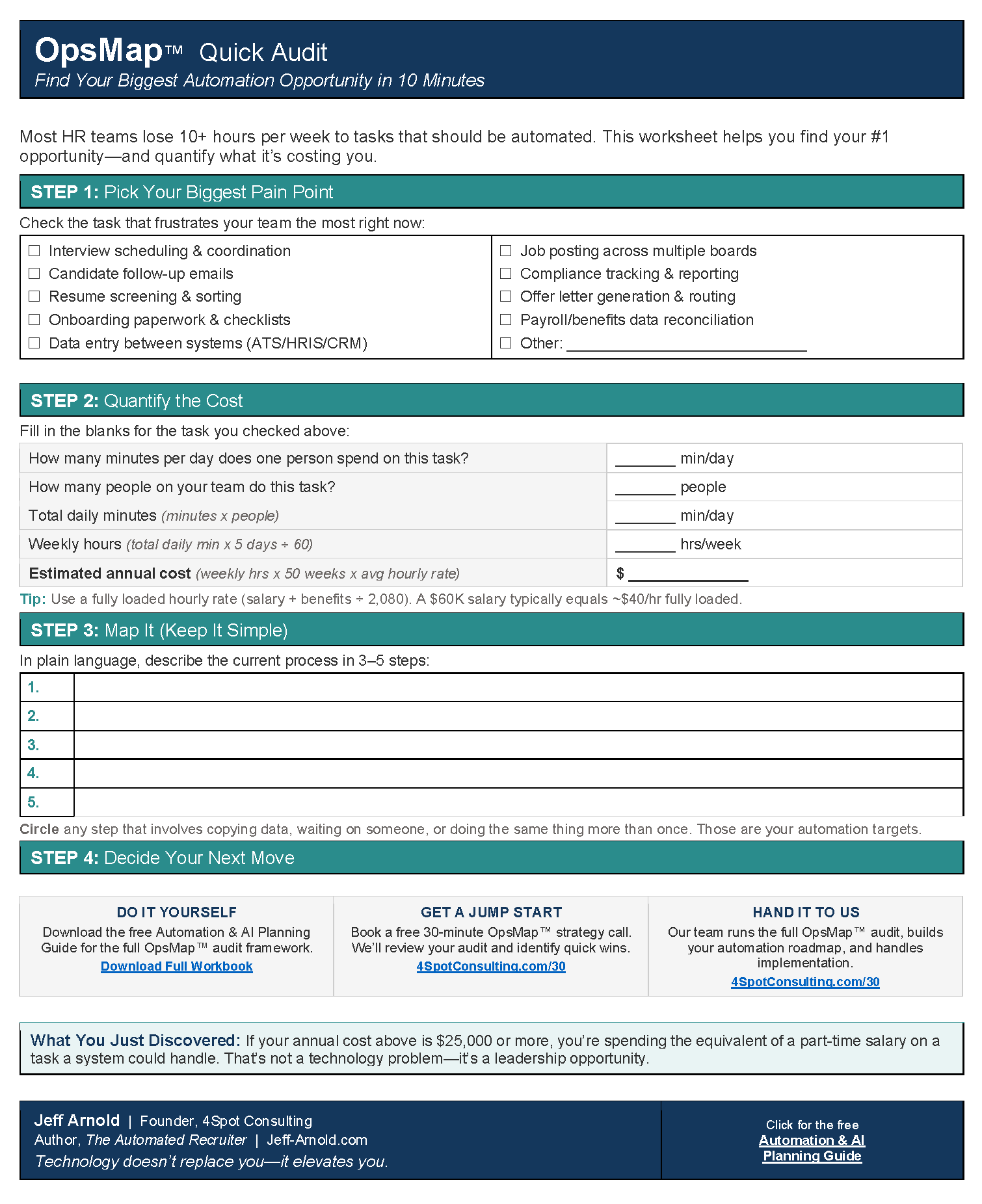
The OpsMap™ assessment process at 4Spot Consulting runs this readiness evaluation across an organization’s full workflow portfolio — identifying which processes meet all three criteria, which need remediation before automation, and which should not be automated at all. Every workflow that reaches production through OpsMap™ has passed all three gates before a single build step begins.
Expert Take
The three readiness criteria are gates, not guidelines. A process that fails criterion one produces an automation that enforces the wrong behavior at machine speed. A process that fails criterion two produces an automation running confidently on bad data. Neither failure is obvious until the damage is already downstream. Run the three gates before any build begins, every time, without exception.
Closing: Sequence Is the Strategy
Intelligent automation is not a feature set to evaluate in a product demo. It is a sequenced practice: document the process, standardize the data, build the structured execution layer, verify it runs clean, then layer AI reasoning at the decision points where variability is unavoidable.
Small businesses that follow this sequence recover compounding value — time, accuracy, capacity, and compliance posture — that accumulates across every workflow they automate. Those that invert the sequence, deploying AI before the structured layer exists, spend that same energy on rework, exception management, and rebuilding trust in outputs that should have been reliable from the start.
For teams ready to map their workflow portfolio before building anything, 10 signs you need clean processes before any HR automation is the diagnostic starting point. For the implementation mistakes that end automation programs before they deliver ROI, 13 HR automation mistakes: a leader’s guide to flawless implementation covers the patterns worth avoiding before you build.
Frequently Asked Questions
What is intelligent automation in simple terms?
Intelligent automation is the combination of rules-based workflow automation with AI capabilities — natural language understanding, predictive suggestions, and adaptive error recovery — so repetitive and moderately complex tasks execute without human intervention.
How is intelligent automation different from regular automation?
Standard workflow automation follows fixed if-then logic. Intelligent automation adds a reasoning layer that interprets unstructured inputs, predicts next steps based on historical patterns, and adjusts behavior when data or conditions change.
Does AI replace workflow automation, or work inside it?
AI works inside a structured automation pipeline — it does not replace it. The repeatable execution layer must exist and run clean before AI augmentation adds value to it.
What business tasks are best suited for intelligent automation?
High-volume tasks that follow recognizable patterns and involve variable inputs — candidate triage, invoice exception handling, lead scoring, and support ticket classification — are the strongest candidates. The common thread is pattern plus variability: enough consistency to automate, enough variation to need reasoning.
Is intelligent automation only relevant to large enterprises?
No. Small businesses with as few as 10 employees benefit, particularly in recruiting, customer communications, and finance operations. The constraint is process maturity, not company size or technical resources.


RELATED POST


