$312K Saved with Keap HR Automation: How TalentEdge Future-Proofed Their HR Tech Stack
Most HR tech stacks are not broken because the tools are wrong. They are broken because the tools are not connected — and every gap between systems is filled by a human doing work a workflow should handle. The Keap expert for recruiting framework starts with that premise and builds from it. This case study shows what it looks like when an organization commits to it fully.
TalentEdge is a 45-person recruiting firm with 12 active recruiters placing candidates across multiple industries. Before their automation build, the firm ran a hybrid of spreadsheets, a standalone ATS, and email campaigns managed manually. Candidates fell through the cracks. Onboarding tasks were tracked in shared documents. Interview reminders were sent — when someone remembered to send them. The firm was growing, but the admin load was growing faster.
The engagement that followed produced $312,000 in documented annual savings and a 207% ROI in 12 months. Here is exactly how it happened.
Snapshot: TalentEdge at a Glance
| Factor | Detail |
|---|---|
| Firm size | 45 people, 12 active recruiters |
| Baseline tech | Standalone ATS, spreadsheets, manual email campaigns |
| Core constraint | No system-to-system automation; every handoff was human |
| Opportunities identified | 9 via OpsMap™ audit |
| Annual savings | $312,000 |
| ROI at 12 months | 207% |
| Primary automation hub | Keap |
Context and Baseline: What “Future-Proof” Means When Nothing Is Connected
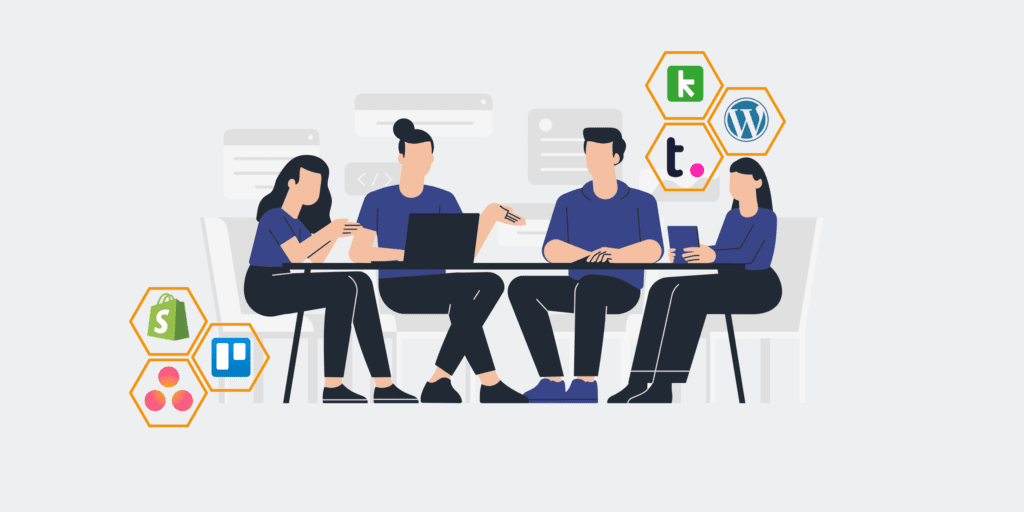
TalentEdge’s problem was not software. It was architecture. The firm had invested in tools — an ATS for tracking applicants, an email platform for outreach, a document system for onboarding — but none of those systems talked to each other. Every transition between stages required a human to copy, paste, notify, or remember.
The consequences were predictable. Parseur’s research on manual data entry costs estimates the burden at $28,500 per employee per year in productivity loss — a figure that compounds quickly across a 12-recruiter team. Gartner’s HR technology research identifies data fragmentation as the primary driver of administrative overhead in mid-market HR operations. McKinsey Global Institute research has consistently found that 45% of workplace tasks can be automated with existing technology — yet most organizations have automated fewer than 20% of those tasks.
TalentEdge was living in that gap. Their recruiters were skilled at sourcing and placing candidates. They were spending a significant portion of their working hours on tasks that a configured workflow could handle in seconds.
Three specific failure patterns stood out in the baseline audit:
- The follow-up gap. Candidates who applied but did not hear back within 48 hours were effectively lost. No automated sequence existed to hold the relationship.
- The transcription risk. Data entered into the ATS was re-entered manually into Keap for communication purposes. Every re-entry was a potential error — the same structural risk that turned David’s $103K job offer into a $130K payroll entry and a $27K loss.
- The onboarding drop. New hire onboarding tasks were tracked in a shared spreadsheet. Items fell through the cracks when recruiters were at capacity, creating compliance gaps and poor first-day experiences.
This is the baseline every future-proof HR tech stack must be measured against: not “do we have the tools?” but “are the tools connected, and are the handoffs automated?”
Approach: The OpsMap™ Before the Build
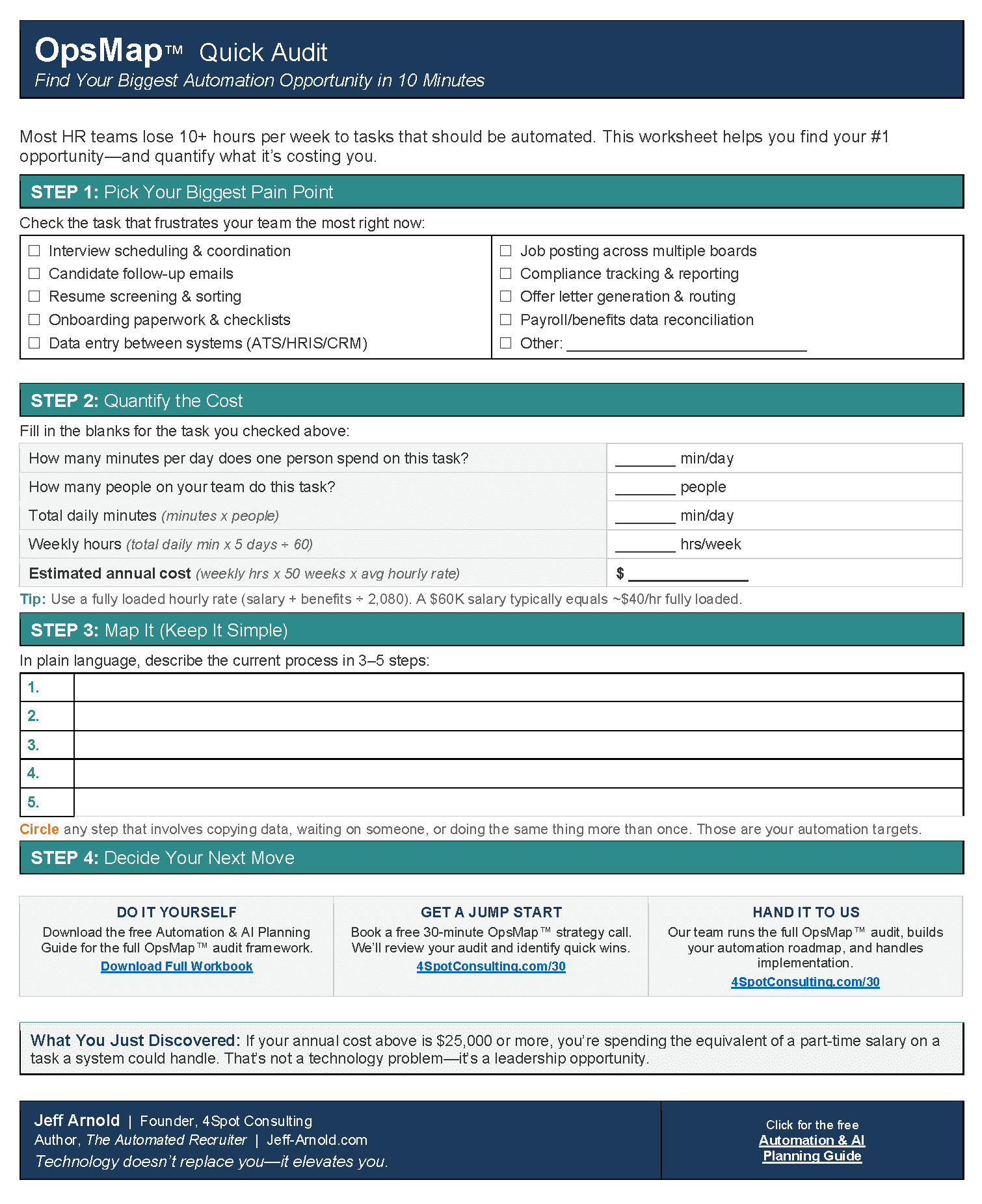
The single most important decision TalentEdge made was to map before building. The OpsMap™ audit is a structured diagnostic that walks through every workflow in a recruiting operation — intake, screening, communication, scheduling, onboarding, compliance — and identifies every manual step that meets the automation criteria: rules-based, repeatable, and high-volume.
For TalentEdge, the OpsMap™ surfaced nine distinct automation opportunities. Not nine nice-to-haves. Nine specific, quantifiable problems where automation would eliminate a manual handoff and return measurable time or reduce measurable error.
The nine opportunities mapped to four workflow categories:
- Candidate intake and data capture — automated form-to-Keap contact creation, eliminating manual ATS-to-CRM transcription.
- Communication sequences — automated follow-up, status update, and re-engagement campaigns triggered by pipeline stage changes in Keap.
- Interview logistics — automated reminder sequences that reduced no-shows without recruiter involvement.
- Onboarding workflow triggers — automated document delivery, task assignment, and compliance deadline tracking initiated the moment an offer tag was applied in Keap.
The OpsMap™ also identified what not to automate. Relationship-sensitive conversations — negotiation calls, rejection delivery for senior candidates, first-day check-ins — stayed human. This distinction matters. Automation is not a replacement for judgment. It is a structure that protects judgment by eliminating the administrative noise around it.
To understand why HR teams need a CRM expert to lead transformation rather than handing this to a generalist admin, TalentEdge’s OpsMap™ phase is instructive. The audit required someone who understood both recruiting workflow and Keap’s tagging, pipeline, and campaign architecture well enough to see the connection between them.
Implementation: Building the Keap-Centered Stack
Implementation followed a deliberate sequence. The team resisted the urge to build everything at once. Priority was assigned based on one criterion: which automation would return the most time or eliminate the highest-risk manual step first.
Phase 1 — Candidate Intake Automation (Weeks 1–4)
The first build eliminated the manual ATS-to-Keap transcription process entirely. Candidate intake forms were redesigned to feed directly into Keap as new contacts with standardized tags indicating source, role, and stage. Within four weeks, twelve recruiters stopped copying candidate data between systems.
The immediate result was data integrity. Every contact in Keap reflected a single authoritative record. Tags were consistent. Pipeline stages were accurate. The foundation for every downstream automation was now trustworthy — which is a prerequisite, not a bonus.
Phase 2 — Communication Sequences (Weeks 5–10)
With clean data in place, the team built Keap campaign sequences for every stage in the candidate pipeline. Application confirmation emails went out within minutes of submission. Stage-change notifications triggered automatically when a recruiter updated a contact record. Candidates who reached a “pending decision” stage received a hold-warm sequence every five days — without any recruiter action required.
This phase directly addressed the follow-up gap identified in the baseline audit. Harvard Business Review research on candidate experience has documented that response speed in the first 48 hours is the single strongest predictor of candidate drop-off. The automated sequences held every relationship in the pipeline, regardless of recruiter bandwidth.
For a detailed look at scaling high-volume hiring with Keap automation, the sequencing logic built in this phase applies directly to operations with 50+ open roles running simultaneously.
Phase 3 — Interview Logistics (Weeks 8–12)
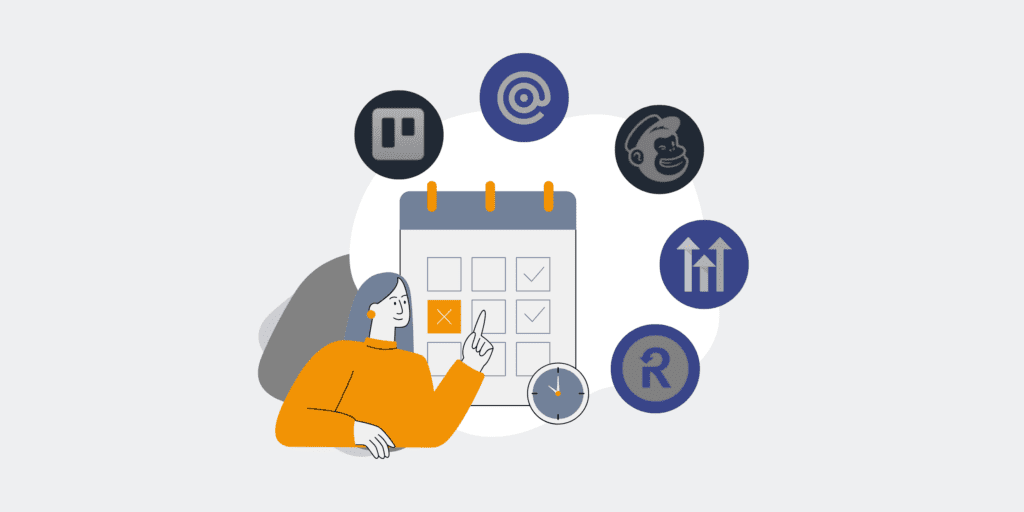
Interview no-shows were costing the team billable recruiter hours and creating candidate experience damage that hurt offer acceptance rates. Automated reminder sequences — 48 hours before, 24 hours before, and morning-of — were configured in Keap and triggered by the interview-scheduled tag.
The no-show rate dropped in the first month. Recruiters did not change their behavior. The system changed the candidate’s experience of the process — making it feel organized, professional, and attentive without requiring a single additional human action.
This mirrors the pattern documented in our work on reducing interview no-shows with Keap automated reminders.
Phase 4 — Onboarding Workflow Triggers (Weeks 10–16)
The onboarding build was the most structurally complex phase because it required coordination across the most systems: Keap, the document management platform, the HRIS, and the compliance checklist. An automation platform connected Keap’s offer-accepted tag to a chain of downstream actions — document packet delivery, IT provisioning request, benefits enrollment deadline notification, and manager task assignment — all triggered from a single tag change.
The shared spreadsheet was retired. Deloitte’s Human Capital Trends research identifies onboarding consistency as a top-three driver of 90-day retention. Building a triggered, consistent onboarding sequence in Keap removed the human memory dependency that had been creating gaps. For a complete look at this architecture, the Keap blueprint for automating new hire onboarding covers each workflow component in detail.
Phase 5 — AI Layer (Month 4 Onward)
AI was not introduced until Phases 1–4 were running cleanly and the team had 90 days of consistent data in Keap. At that point, AI-assisted resume screening was integrated as a pre-stage filter, scoring inbound applications before they created a Keap contact record. Because the tagging taxonomy was already established and the pipeline stages were stable, the AI outputs mapped directly into the existing workflow without any manual translation.
This sequencing — automation first, AI second — is not a preference. It is a structural requirement. AI that feeds into a broken manual process inherits the chaos of that process and amplifies it. AI that feeds into a stable Keap automation spine produces clean, actionable outputs at every stage.
Results: The Numbers Behind 207% ROI
At 12 months post-implementation, TalentEdge documented the following outcomes:
- $312,000 in annual savings — drawn from recruiter time reclaimed, error-driven rework eliminated, and candidate drop-off reduced.
- 207% ROI — measured against the full cost of the OpsMap™ audit and all four implementation phases.
- 9 automation opportunities — all 9 identified in the OpsMap™ were built and operational within the 12-month window.
- Onboarding consistency — zero missed onboarding tasks in the six months following Phase 4 deployment, compared to a documented gap rate of approximately one missed item per three hires in the baseline period.
- Candidate communication latency — reduced from an average of 3.2 days to under 4 hours for stage-change notifications, driven entirely by automated sequences.
Forrester’s research on automation ROI consistently finds that the highest returns come from workflow automation applied to high-frequency, rules-based processes — exactly the pattern TalentEdge executed. SHRM’s cost-of-vacancy research documents average costs of $4,129 per unfilled position per month; the candidate communication improvements alone accelerated average time-to-fill and reduced that exposure meaningfully across a 12-recruiter operation.
For context on how to read these numbers against your own operation, the Keap analytics framework for measuring recruitment ROI provides the measurement structure TalentEdge used to track these outcomes from week one.
Lessons Learned: What We Would Do Differently
Transparency requires acknowledging where the execution could have been tighter.
The data hygiene phase was underestimated. Before Phase 1 could run cleanly, the existing contact data in Keap needed to be audited and deduplicated. That work added two weeks to the intake automation build. Future engagements now include a mandatory data audit as a standalone pre-phase before any workflow construction begins.
Change management received less attention than the technical build. The recruiters who used the new Keap workflows most effectively were the ones who understood why each automation existed — not just how to use it. Teams that received a brief workflow rationale alongside technical training adopted the new system faster and with fewer workaround behaviors. Documentation and rationale delivery are now built into every implementation phase.
The AI layer should have been scoped earlier, even if deployed later. Knowing in Phase 1 what data fields the AI resume screener would need allowed the tagging taxonomy to be designed with those requirements in mind. In TalentEdge’s case, one tag field had to be retrofitted after Phase 4 to support the AI integration. It was a small rework — but a preventable one.
A structured Keap recruitment automation health check at the end of each phase would have caught the tag field gap earlier. That practice is now standard in post-phase reviews.
What a Future-Proof HR Tech Stack Actually Requires
The TalentEdge outcome is replicable — but only if the underlying architecture decisions are the same. A future-proof HR tech stack is not defined by which tools it contains. It is defined by whether those tools are connected, whether data flows without human re-entry, and whether workflows execute without human triggers.
That architecture requires three commitments:
- Map before you build. The OpsMap™ is not a luxury. It is the diagnostic that separates automation that solves real problems from automation that digitizes existing chaos.
- Automate before you AI. AI earns its place inside a stable automation spine. It does not replace the spine.
- Measure from day one. Every automation opportunity in TalentEdge’s OpsMap™ had a success metric before the build began. That discipline is what made the 207% ROI measurable — and defensible.
For HR leaders asking whether their current stack is positioned to scale, the hidden costs of recruiting without automation are the place to start. The gap between what your recruiters are currently doing manually and what a configured Keap automation stack would handle for them is, almost certainly, larger than you think.
To see how Keap stacks up against traditional ATS platforms on the specific capabilities that drove TalentEdge’s results, the comparison of how Keap compares to a traditional ATS for talent acquisition speed provides the side-by-side analysis. And for teams ready to measure the state of what they have built, Keap analytics for data-driven recruitment decisions covers the reporting framework that keeps a future-proof stack actually performing over time.
The future-proof HR tech stack is not a destination. It is a discipline. TalentEdge’s $312,000 in savings did not come from buying the right software. It came from connecting the software they had and removing every manual handoff between them.