

Post: Automate HR: 7 Make.com Modules for Webhook Workflows
7 Indispensable Make.com Modules to Supercharge Your Webhook-Driven HR Automation
In today’s fast-paced recruiting and HR environment, manual processes are not just time-consuming; they’re a significant bottleneck to efficiency, candidate experience, and ultimately, your organization’s growth. High-growth B2B companies, in particular, demand agility and precision in their talent acquisition and management strategies. This is where automation, powered by platforms like Make.com, becomes not just an advantage, but a necessity. Make.com, with its intuitive visual builder, empowers HR and recruiting professionals to connect disparate systems and automate complex workflows without needing to write a single line of code. The real magic often begins with webhooks – the invisible connectors that allow applications to communicate in real-time. By leveraging webhooks, you can transform how you handle everything from candidate applications to onboarding, freeing up your high-value employees from low-value, repetitive tasks. We’ve seen firsthand how intelligently designed automations can reduce human error, slash operational costs, and significantly increase scalability. For HR leaders, COOs, and recruitment directors, understanding the core Make.com modules essential for webhook-driven automation is critical to unlocking these efficiencies. This article will delve into seven such indispensable modules that form the backbone of a truly automated, intelligent HR operation.
At 4Spot Consulting, our mission is to save you 25% of your day by architecting automation and AI solutions that are strategic and ROI-focused. We’ve helped numerous clients streamline their HR processes, transforming manual drudgery into seamless, automated workflows. This isn’t about implementing tech for tech’s sake; it’s about solving real business problems and driving tangible outcomes. The modules we’re about to explore are the building blocks we use to connect your ATS, CRM, HRIS, e-signature platforms, and more, ensuring a single source of truth for your data and eliminating costly bottlenecks. Let’s dive into how these Make.com modules can supercharge your HR automation, turning reactive tasks into proactive, efficient processes that elevate your entire talent ecosystem.
1. Webhooks (Custom Webhook)
The Webhooks module is the entry point for nearly all real-time, event-driven HR automations in Make.com. Think of it as the ears of your automation — constantly listening for specific events from other systems. In HR, this could be anything from a new candidate application submitted via your ATS, an interview scheduled in your calendar software, a feedback form completed by a hiring manager, or even a new employee record created in your HRIS. The “Custom Webhook” specifically provides a unique URL that you can configure in any external application that supports sending webhook payloads. When an event occurs in that external system, it sends a package of data (the payload) to your Make.com webhook URL, instantly triggering your scenario.
The power of the Webhooks module lies in its immediacy and flexibility. Instead of polling systems at set intervals (which can be slow and resource-intensive), webhooks react instantly. For example, when a candidate applies through Greenhouse or Workable, a webhook can immediately send their details to a Make.com scenario. This scenario could then automatically create a new contact in your Keap CRM, send a personalized acknowledgment email to the candidate, initiate a background check request via an external API, or even trigger an internal Slack notification for the recruitment team. The Webhooks module eliminates manual data entry, reduces delays in candidate communication, and ensures that critical HR processes begin the moment an event happens. It’s the cornerstone of creating truly responsive and efficient HR workflows, allowing you to capture and act on data the moment it becomes available, thereby enhancing candidate experience and operational speed. Without this foundational module, your HR automations would lack the real-time responsiveness that modern talent acquisition demands, leading to missed opportunities and slower cycle times.
2. HTTP (Make a Request)
While the Webhooks module brings data into Make.com, the HTTP module is your gateway to sending data out and interacting with virtually any web service or API. This module allows your Make.com scenarios to act as a client, making custom HTTP requests (GET, POST, PUT, DELETE) to external systems. In HR automation, this is absolutely indispensable for integrating with tools that don’t have a native Make.com integration or for executing highly specific API calls beyond the scope of existing connectors. For example, after receiving a new applicant via a webhook, you might need to send a POST request to a specialized background check provider’s API to initiate a check, or a PUT request to update a candidate’s status in a niche HRIS that lacks robust webhook capabilities. You might also use it to retrieve additional candidate data from an external talent database using a GET request based on a candidate ID received in an initial webhook payload.
The HTTP module gives you unparalleled control over how your Make.com scenarios communicate with other platforms. You can configure headers, query parameters, and the request body to precisely match the requirements of any API. This capability is crucial for connecting proprietary systems, legacy HR platforms, or highly specialized HR tech tools that are vital to your operations. We’ve leveraged the HTTP module to connect disparate systems, such as pushing parsed resume data into a custom talent pool database or triggering specific actions in an e-signature platform for offer letters. It ensures that your HR automation is not limited by the availability of pre-built integrations but can instead reach out to any system with an accessible API, creating a truly unified and seamless HR tech stack. This flexibility is a game-changer for high-growth companies looking to integrate best-of-breed tools without being constrained by integration limitations, ensuring every piece of your HR puzzle can communicate effectively.
3. Router
The Router module in Make.com is your essential tool for creating conditional logic and branching workflows within your HR automations. After a webhook triggers a scenario, the data received often requires different actions depending on its content or origin. The Router allows you to create multiple paths from a single input, directing the flow of data to different sets of operations based on predefined conditions. For instance, imagine your Webhooks module receives new applications. A Router can examine the candidate’s preferred job role, years of experience, or even their location, then send the application down different paths: one for senior roles that requires an immediate calendar invite for a screening call, another for junior roles that triggers a skills assessment, and a third for international applicants that initiates a visa pre-screening process.
Each path stemming from the Router can have its own filters, ensuring that only data meeting specific criteria proceeds down that particular route. This prevents unnecessary processing and ensures that the right actions are taken for the right circumstances. In HR, this translates to highly personalized and efficient candidate journeys, as well as optimized internal workflows. We use Routers extensively to manage different stages of the recruitment funnel, from initial application to offer generation. It ensures that every candidate receives the appropriate communication and moves through the correct process without manual intervention. This dramatically reduces administrative overhead, minimizes human error in decision-making, and allows HR professionals to focus on strategic tasks rather than manually triaging every incoming piece of data. The Router is key to building intelligent, adaptive, and scalable HR automations that can handle the complexity of modern talent management.
4. Data Store
The Data Store module in Make.com acts as a simple, integrated database directly within your Make.com environment. It allows you to store, retrieve, update, and delete structured data that your scenarios need to access or persist over time. Unlike temporary variables that exist only within a single scenario run, Data Stores provide persistent storage, making them incredibly valuable for maintaining context across multiple scenario executions or for holding configuration data. In HR automation, this module can be a powerful tool for managing a variety of dynamic information. For example, you could use a Data Store to maintain a list of active job requisitions and their associated hiring managers, a roster of approved background check vendors, or a log of candidate interactions to ensure no duplicate communications are sent.
Consider a scenario where a webhook receives an application for a specific job ID. Before processing, your scenario could query a Data Store to fetch details about that job – the department, the hiring manager’s email, the interview panel, or even specific screening questions. This eliminates the need to hardcode values or make repeated API calls to your HRIS for static information. Another common use case is managing rate limits for external APIs or tracking the number of times a certain action has been performed for a candidate. By storing and updating counts in a Data Store, you can prevent your automations from over-calling an API or sending excessive notifications. For 4Spot Consulting, Data Stores are instrumental in creating robust and resilient automations, ensuring that crucial reference data is always at hand, accessible, and easily maintainable. This provides a significant layer of flexibility and intelligence to HR workflows, allowing them to adapt to changing organizational needs without constant scenario modifications.
5. CRM Module (e.g., Keap, HubSpot, Salesforce)
Integrating your HR automation with your Customer Relationship Management (CRM) system is paramount, especially for recruitment firms and high-growth B2B companies where candidate experience mirrors customer experience. Make.com offers robust modules for popular CRMs like Keap, HubSpot, Salesforce, and many others. These modules allow you to seamlessly create, update, search for, and link records within your CRM based on events triggered by webhooks. For HR, this means that every candidate can be treated as a valuable prospect, ensuring a consistent and personalized journey from application to onboarding.
When a webhook alerts your Make.com scenario to a new applicant, the CRM module can instantly create a new contact record in your chosen CRM. This record can be enriched with data from the application, such as resume details, contact information, and desired job role. As the candidate progresses through the hiring funnel, subsequent webhook events (e.g., interview scheduled, offer extended) can be used to update their status in the CRM, add notes, or even trigger automated follow-up sequences. This ensures that your recruitment team has a 360-degree view of every candidate, centralizing communication history and engagement data. Beyond candidates, CRM integration is vital for managing relationships with hiring managers, recruitment agencies, and other stakeholders. By ensuring your HR data lives in harmony with your CRM, you eliminate data silos, reduce manual data entry, and enable powerful segmentation and nurturing strategies. For 4Spot Consulting, integrating HR processes with a robust CRM like Keap is fundamental to building a “Single Source of Truth,” enabling powerful analytics and personalized engagement that drives both efficiency and superior outcomes in talent acquisition.
6. Text Parser
The Text Parser module in Make.com is a hidden gem for HR automation, especially when dealing with unstructured or semi-structured text data received via webhooks. Modern HR often involves extracting specific pieces of information from emails, resumes, application forms, or feedback submissions that might not be neatly compartmentalized. The Text Parser module provides powerful functions to manipulate, extract, and format text strings, allowing you to transform raw data into usable insights. For example, a webhook might bring in a candidate’s full resume text. You could use the Text Parser to extract specific details like email addresses, phone numbers, years of experience (using regular expressions), or even identify keywords related to specific skills. Another common use is cleaning up data – removing unwanted characters, standardizing date formats, or splitting a full name into first and last names for separate CRM fields.
Consider a scenario where interview feedback is submitted via a simple text field in a form. The Text Parser can be used to identify key sentiment indicators or action items within that feedback. Or, if you’re receiving email notifications via a mailhook (often processed with an HTTP module fetching email content, then parsing it), the Text Parser can extract the sender, subject, and body, allowing you to route and process these emails intelligently. This module is crucial for taking messy, real-world data and making it structured and actionable for downstream modules like your CRM or AI tools. It dramatically reduces the need for manual review and data preparation, ensuring that your HR automations can handle a wider variety of inputs with greater accuracy and efficiency. For us at 4Spot Consulting, the Text Parser is a go-to for making sense of the “noise” in data, turning it into valuable signals that drive smarter HR decisions.
7. OpenAI / Bland AI (or Similar AI/NLP)
Integrating AI and Natural Language Processing (NLP) capabilities into your webhook-driven HR automations is where the real competitive advantage lies. Modules like OpenAI or Bland AI (which 4Spot Consulting frequently leverages for its specialized automation capabilities) allow your Make.com scenarios to go beyond simple data routing and perform intelligent analysis and content generation. When a webhook brings in a new candidate application, resume, or interview transcript, an AI module can instantly enrich that data in ways no rule-based automation ever could. For instance, you could use OpenAI to summarize a lengthy resume into key bullet points for a hiring manager, extract core competencies, or even identify potential culture fit based on a candidate’s past experience descriptions.
Bland AI, specifically designed for AI-powered operations, can take this a step further by orchestrating more complex AI tasks, such as generating personalized follow-up questions for an interviewer based on a candidate’s profile, or drafting a tailored rejection email that maintains a positive candidate experience. Another powerful application is sentiment analysis on candidate feedback or employee engagement surveys received via webhooks, providing immediate insights into areas of concern or satisfaction. This allows HR teams to be proactive and address issues quickly. By automating these cognitive tasks, you free up your high-value HR professionals to focus on human connection and strategic decision-making. We’ve helped clients save countless hours by automating resume parsing, initial candidate screening, and even personalized communication generation using these powerful AI modules. This not only eliminates human error in repetitive tasks but also dramatically scales the capacity of your HR team, allowing you to process more candidates faster and smarter, aligning perfectly with 4Spot Consulting’s goal of saving you 25% of your day.
The landscape of HR and recruiting is rapidly evolving, with automation and AI at the forefront of driving efficiency and strategic advantage. By mastering these seven indispensable Make.com modules – Webhooks, HTTP, Router, Data Store, CRM Integration, Text Parser, and AI/NLP tools – HR and recruiting professionals can transform their operations from reactive to proactive, from manual to intelligent. These modules are the building blocks for creating robust, scalable, and error-free workflows that save countless hours, reduce operational costs, and significantly enhance the candidate and employee experience. They empower your team to focus on what truly matters: people, strategy, and growth.
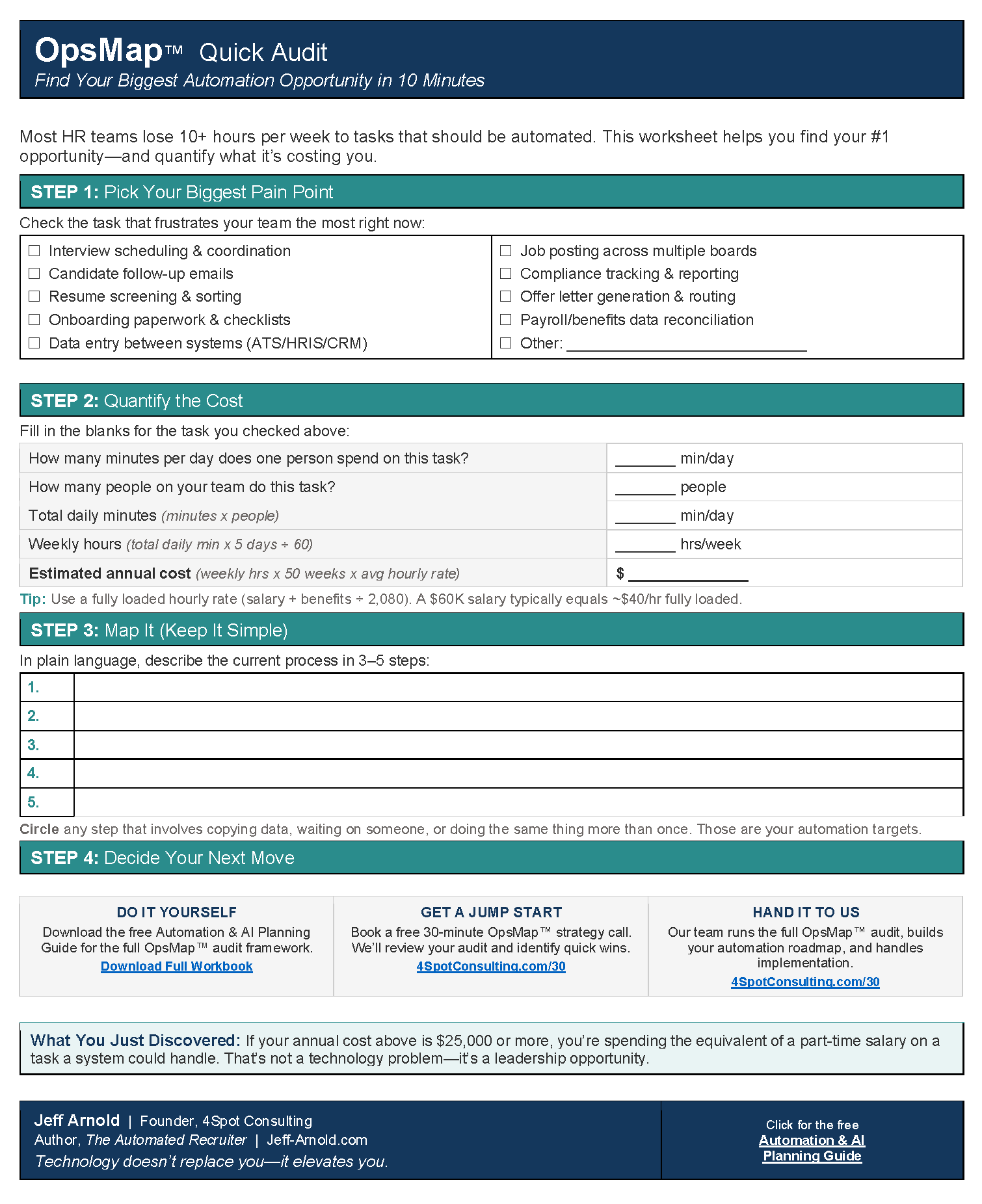
At 4Spot Consulting, we specialize in architecting these very solutions. We understand the pain points of high-growth B2B companies struggling with manual processes and disconnected systems. Our OpsMap™ strategic audit is designed to uncover your unique inefficiencies and roadmap profitable automations using Make.com and AI, ensuring every solution is tied directly to ROI and business outcomes. Don’t let manual drudgery hold your HR team back. The future of intelligent HR automation is here, and it’s built with these powerful modules.
If you would like to read more, we recommend this article: Webhook vs. Mailhook: Architecting Intelligent HR & Recruiting Automation on Make.com


RELATED POST

