Is a forward-deployed engineer different from an HR automation consultant who hands you a plan?
Yes. A forward-deployed engineer works inside your HR and recruiting operation, builds the automations and AI workflows in your live systems, and keeps adjusting them as your process changes. An HR automation consultant who hands you a plan delivers a diagnosis and a roadmap. After that, someone on your side still has to build, test and run everything the plan describes. The difference is who carries the work from paper into production.
Key takeaways
- A plan tells you what to automate. A forward-deployed engineer puts it into your systems and keeps it working.
- A plan-only engagement leaves the build, the testing and the upkeep with your team.
- A forward-deployed engineer with no clear plan automates whatever process exists, mistakes included.
- When automation work comes in bursts, a fractional forward-deployed engineer fits the workload better than a full-time hire.
What does a forward-deployed engineer do that a plan does not?
A forward-deployed engineer turns the plan into working automation inside your own tools. In an HR operation, the engineer learns how your intake, screening, offer and onboarding steps run day to day. Then they connect the systems involved and write the logic that moves data between them.
The role is hands-on and close to the people doing the work. When a hiring manager adds an approval step or a new requisition type appears, the engineer adjusts the build that week instead of waiting for a new engagement.
- Maps the process as it runs today, not as the org chart says it runs.
- Builds the integrations and AI steps in your systems, for example on Make.com.
- Tests with your own data and edge cases, such as a candidate who applies twice or an offer that changes after approval.
- Stays close enough to the team to adjust the build when the process changes.
What does an HR automation consultant who hands you a plan deliver?
A plan-only consultant delivers a document: where time goes, which steps to automate first, and what each change involves. That work has value. A good plan ranks the work by payoff, names the systems involved, and keeps you from automating a broken process.
The plan does not include the build. After the handoff, your team has to find someone to configure the integrations, write the logic, test it and keep it running. If nobody owns that step, the plan stays in a folder and recruiters keep re-entering candidate data by hand. Our guide on the role of an HR automation consultant in workflow transformation covers what a strong plan contains.
Where does each approach break down?
Each approach breaks down in a predictable place.
- A plan with no builder. The plan ages. Systems update, people change roles, and by the time someone starts building, several of the plan’s assumptions are out of date.
- A builder with no plan. The engineer automates what is in front of them. If your offer approval has four handoffs nobody needs, the engineer builds four automated handoffs.
- Knowledge held by one person. Whether the knowledge lives in a consultant’s report or an engineer’s memory, it has to be written down where your team can find it, or the next change starts from zero.
Expert Take
We hear this choice framed as plan versus build. That framing misses who owns the work after go-live. A plan with no builder stalls in a folder. A builder with no plan automates a messy process, mistakes included. Our position is automation first, then AI: map and standardize the process, deploy it, then keep someone close enough to adjust it. For an HR operation, a fractional forward-deployed engineer working from a current plan covers the build and the upkeep without a full-time seat that sits idle between projects.
Should the forward-deployed engineer be full time or fractional?
We recommend a fractional forward-deployed engineer, working part-time or by the project, over a full-time hire for an HR and recruiting operation. The reasons come from the work itself.
- How much work there is. HR automation arrives in bursts: a new applicant tracking system, an onboarding rebuild, a change to how offers get approved. Between those bursts, the work is upkeep, and upkeep does not fill a full-time week.
- Ramp time. A full-time hire spends weeks learning your systems, your people and your exceptions before the first build goes live. With a fractional engineer, you choose someone who has already built similar HR workflows and bring them in for a defined piece of work.
- The idle seat. Between projects, a full-time seat costs the same whether or not there is work to do.
- Knowledge when one person leaves. With a single full-time engineer, the knowledge of every scenario leaves when they do. A fractional arrangement only works when the build is documented, so documentation becomes part of the job from day one.
For the full comparison, including the cases where a full-time hire makes sense, read our guide on whether to hire a forward-deployed engineer or a fractional one.
Common questions about the two roles
Can one firm both plan and build?
Yes, one firm or one person can do both, and that removes the handoff between the plan and the build. Before you start, ask who writes the plan, who builds it, and who owns it after go-live, and get a name for each.
Does a forward-deployed engineer replace my HR team?
No. The engineer builds the systems, and your recruiters and HR staff still run hiring, make the judgment calls and own the candidate relationships. Technology doesn’t replace people – it elevates them.
Is a plan wasted if we bring in an engineer later?
No. A current plan gives the engineer a ranked list of work and cuts the time spent rediscovering your process. Check the date on it: a plan built around systems you have since replaced needs an update before anyone builds from it.
Why getting this right matters, and where help fits
Getting this right decides whether your HR automation runs in production or stays on paper. When the plan and the build are split with no owner between them, you end up with a document nobody uses or automations nobody maintains. Either way, recruiters keep chasing approvals by email, candidate data lives in different places, and high-value people keep doing low-value work.
Outside help earns its place here because the early design decisions are hard to undo: which system holds the source of truth, how errors get caught, and who owns each automation after launch. Getting those wrong means rebuilding later.
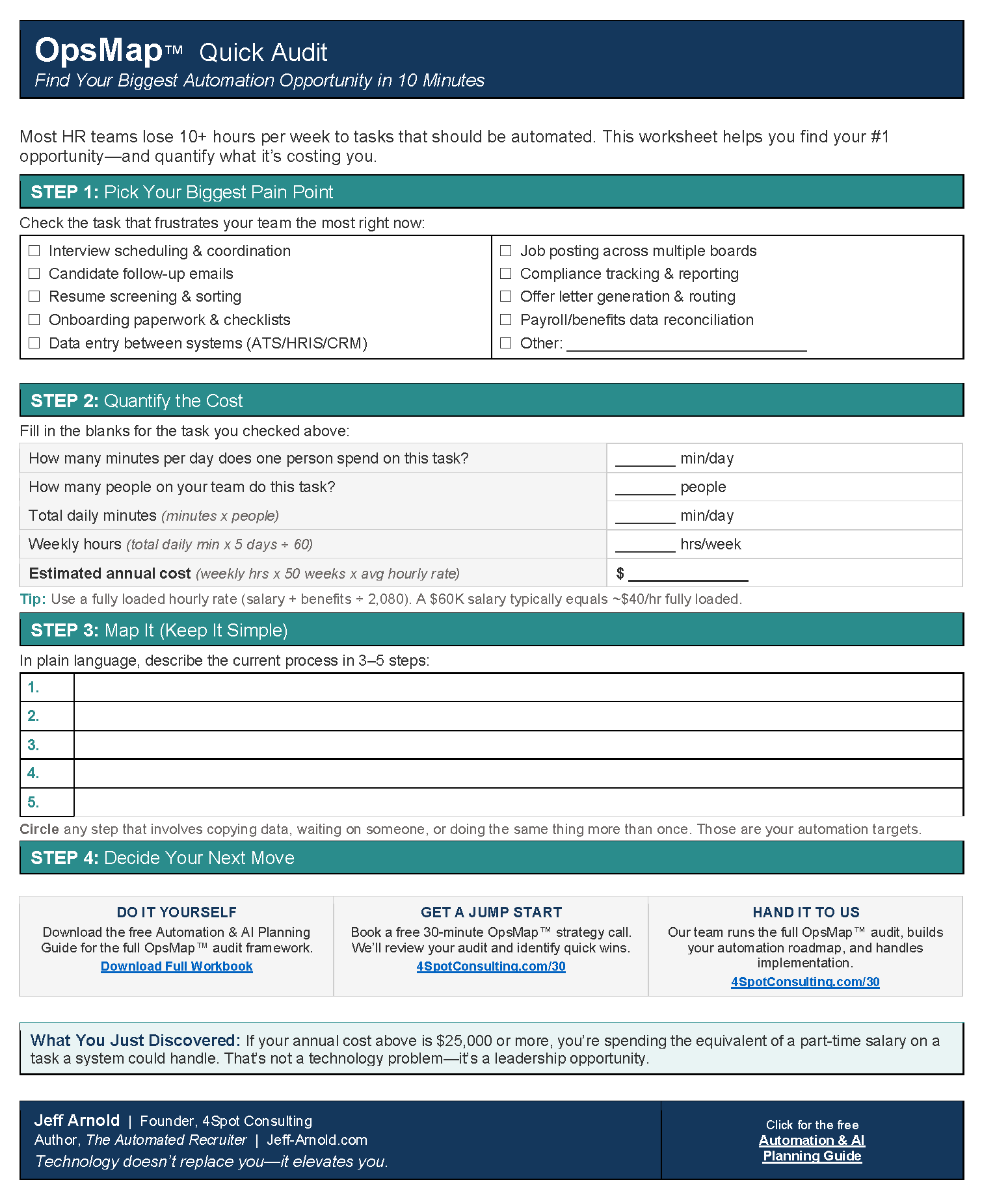
4Spot Consulting is a team of consultants who help companies deploy AI. We help you decide what AI and automation work you have, how much of it there is, and what order to do it in. Then we help you deploy it on Make.com so it runs inside the systems your team already uses. Our OpsMap™ starts with that decision, so the plan and the deployment come from the same understanding of your process. Our focus is automation and AI done right, built on Make.com.
Next steps
If you are deciding between a plan, a build or a fractional forward-deployed engineer for your HR operation, contact 4Spot Consulting and we will help you size the work first.