

Post: Make vs. Zapier for HR Automation: Deep Comparison
Table of Contents
- What Is Make vs. Zapier for HR Automation, Really?
- Core Concepts You Need to Know
- Why HR Automation Fails in Most Organizations
- The Contrarian Take the Industry Gets Wrong
- Where AI Actually Belongs in HR Automation
- The Highest-ROI Tactics to Prioritize First
- Operational Principles Every Build Must Include
- How to Identify Your First Automation Candidate
- How to Choose the Right Approach for Your Operation
- How to Implement HR Automation Step by Step
- How to Make the Business Case
- Common Objections and How to Answer Them
- What a Successful Engagement Looks Like in Practice
- Next Steps: From Reading to Building
Make and Zapier are both valid HR automation platforms — but the right choice turns on a single question: does your HR process branch conditionally or run in a straight line? Branching workflows — offer approval chains, onboarding task trees sorted by role type — belong on Make. Linear trigger-action sequences belong on Zapier. Architecture determines the answer, not feature lists.
This guide cuts through the vendor noise, defines the decision on operational terms, and maps the exact sequence that produces sustained ROI. If you want a surface-level tool comparison, this is not it. If you want the framework that determines which platform fits your HR operation — and where AI belongs inside it — read on.
What Is Make vs. Zapier for HR Automation, Really — and What Isn’t It?
Make vs. Zapier for HR automation is the discipline of building structured, reliable pipelines for the repetitive, low-judgment work that consumes a significant portion of an HR team’s day — not the AI transformation that vendors market on landing pages.
HR automation, regardless of platform, eliminates manual steps in processes where the correct next action is already known. When a candidate reaches “offer extended” status in the ATS, the correct next action is to trigger the HRIS record creation, the background check vendor notification, and the hiring manager confirmation email. No one needs to decide that sequence in the moment — it is deterministic. Automation handles it. The platform — Make or Zapier — is the infrastructure that executes the logic reliably.
What HR automation is not: it is not AI, it is not a replacement for human judgment in complex hiring decisions, and it is not a transformation project that requires a six-month change management program before anything ships. Being precise about what you are actually building is where the decision starts.
McKinsey Global Institute research consistently shows that the HR function contains a high proportion of automatable tasks relative to its total workload — specifically the data collection, data processing, and predictable administrative work categories. The automation opportunity in HR is documented and large. The question is whether organizations build the right infrastructure to capture it.
Make and Zapier are both no-code automation platforms that connect disparate software systems and execute workflow logic without requiring developers. Make uses a visual canvas where scenarios branch, loop, and route data through multiple paths simultaneously. Zapier uses a linear editor where a single trigger fires a sequential chain of actions. That architectural difference — branching canvas versus linear chain — is the single most important thing to understand before choosing between them for HR work.
What Are the Core Concepts You Need to Know About Make vs. Zapier for HR Automation?
Six terms appear in every platform evaluation and every vendor pitch. Understanding them on operational grounds prevents expensive misalignments between what was promised and what was built.
Trigger. The event that starts the automation. In HR contexts: a new application submitted, a candidate status changed, a job offer signed, an employee record updated. Every automation starts with exactly one trigger.
Action. The downstream step the automation executes in response to the trigger. Multiple actions can chain from a single trigger. In Zapier, those actions are sequential. In Make, they can be parallel or conditional.
Scenario (Make) / Zap (Zapier). The complete automation — trigger plus all actions. Make calls its automations scenarios. Zapier calls them Zaps. The naming difference is cosmetic; the architectural difference is structural.
Conditional logic (router/filter). The rules that determine which branch of an automation fires based on the data present. In Make, routers direct records down different paths simultaneously based on conditions. In Zapier, filters stop or pass records through a linear sequence. Multi-branch conditional logic in Zapier requires multiple Zaps; in Make, it is a single scenario with a router. This structural advantage is why complex HR approval chains belong on Make and not Zapier — a point covered in depth in 11 Make.com features that elevate HR automation beyond Zapier.
Webhook. A real-time data push from one system to another. Webhooks allow automations to fire instantly when an event occurs rather than polling on a schedule. Critical for time-sensitive HR workflows — interview confirmations, offer acceptances, urgent onboarding triggers.
API connection. The integration layer that allows the automation platform to read from and write to HR systems. The quality of the API — whether it supports bi-directional data flow, webhook events, and granular field access — determines what is actually automatable regardless of platform choice. Evaluating an ATS or HRIS on its API quality is more operationally relevant than evaluating it on its UI.
Audit trail. The log of what the automation did — which records it touched, what values were before, what values are after, and when the change occurred. A production-grade HR automation has an audit trail. A prototype does not. The difference matters when compliance or a data discrepancy requires reconstruction of what happened.
Why Is HR Automation Failing in Most Organizations?
The failure mode is consistent: organizations deploy AI in HR automation before building the automation spine. The result is AI running on top of unstructured, inconsistent data — producing bad output, generating distrust in the technology, and entrenching the belief that “AI doesn’t work for us.” The technology is not the problem. The missing structure is.
Research on knowledge worker time allocation identifies that a significant portion of each workday goes to “work about work” — status updates, file transfers, manual notifications, and data entry that coordinates tasks rather than completes them. That category of work is precisely what automation eliminates. When organizations skip building the automation spine and deploy AI overlays instead, the work-about-work remains. AI adds a new layer of complexity on top of existing chaos.
The second failure mode is platform mismatch. An HR team with genuinely complex conditional workflows — offer approval routing that branches based on salary band, location, and department; onboarding task trees that vary by role type and employment classification — deploys Zapier because it has a gentler learning curve. Within 90 days, the team maintains 40 separate Zaps that partially replicate each other, with no single source of truth for the logic. The maintenance burden exceeds the time savings. This is the pattern that drives advanced users to outgrow Zapier for complex automation — not frustration with the tool, but architectural incompatibility with the process complexity they are actually managing.
The third failure mode is building without logging. An automation runs for six weeks. A data discrepancy surfaces in payroll. No one can reconstruct what the automation did because no change log was built in. The investigation takes longer than the original problem would have taken to fix manually. Trust in automation collapses. The hidden cost of poorly-built automation is equally real as the cost of manual processes — and far less discussed. Ten real examples of why clean processes must come before automation maps exactly where these failures originate.
Expert Take
Every week I talk to HR leaders who have already bought a platform — Make or Zapier — and are now trying to figure out what to do with it. That is the wrong sequence. The platform choice is downstream of the workflow architecture question: does your process branch based on conditions, or does it move in a straight line? Answer that first. Then pick the platform that fits the answer. Most simple HR notifications and status updates are linear. Most multi-system data flows with conditional routing — offer approval chains, onboarding task trees — are not. Get the architecture right and the platform choice becomes obvious.
What Is the Contrarian Take on Make vs. Zapier for HR Automation the Industry Gets Wrong?
The industry deploys AI in HR automation before building the automation spine — and calls the result an AI-powered HR transformation. Most of what vendors label “AI-powered HR automation” is a standard automation workflow with a single AI step bolted onto the marketing copy. The honest take: AI belongs inside the automation, not instead of it. And it belongs at a specific location inside the automation — not everywhere.
The vendor narrative frames AI as the primary value driver and automation as the infrastructure that enables it. That framing is backwards. Automation is the primary value driver — it eliminates the substantial share of HR workday consumed by low-judgment, repetitive tasks. AI adds incremental value at the specific judgment points where automation’s deterministic rules cannot produce a reliable answer alone. Reversing the priority order produces worse outcomes and higher costs.
Gartner research on HR technology adoption consistently shows that organizations overestimate AI readiness and underestimate data quality requirements. AI models — whether embedded in an automation platform or accessed via API — require structured, consistent, clean input to produce reliable output. The automation spine produces that structured input. Building AI without the spine is deploying a sophisticated analytics dashboard on top of a spreadsheet with inconsistent date formats: the output looks authoritative but the data underneath does not support it.
The second contrarian point: the Make-versus-Zapier debate is a proxy for a more important conversation about workflow architecture. Organizations that frame the decision as a feature comparison — native integrations, pricing tiers, AI capabilities — optimize for the wrong variable. The right variable is architectural fit. Does your HR process require linear trigger-action execution or multi-branch conditional routing? That single question determines the platform. Everything else is secondary.
Where Does AI Actually Belong in Make vs. Zapier for HR Automation?
AI earns its place inside the automation at the specific judgment points where deterministic rules fail. Everything else is handled more reliably by structured automation logic — faster, cheaper, and with no hallucination risk.
The three judgment points in HR automation where AI genuinely adds value are fuzzy-match deduplication, free-text interpretation, and ambiguous-record resolution. Each represents a specific location inside the pipeline where a rule-based approach produces unacceptable error rates.
Fuzzy-match deduplication. When the same candidate applies through multiple channels — job board, direct apply, referral — the ATS creates multiple records with slight name or email variations. A deterministic rule catches exact duplicates. It cannot catch “Jonathan Smith” and “Jon Smith” as the same person. An AI step inside the automation — positioned after new application ingestion — resolves the ambiguity and flags or merges the record before downstream processes create compounding errors.
Free-text interpretation. Job requisitions, interview notes, and candidate assessments contain unstructured text that needs conversion into structured data for downstream routing. AI extracts the relevant fields — seniority level, required skills, location flexibility — from free text and maps them to structured values. The automation then routes the record using those structured values. AI handles the interpretation; automation handles the routing.
Ambiguous-record resolution. When a record arrives with a field value that does not match any option in the destination system — a job title that exists in the ATS but has no equivalent in the HRIS — a deterministic rule fails or errors. An AI step interprets the closest match and either resolves it automatically or routes it to a human reviewer with a recommended action. This is the correct human-in-the-loop design: AI narrows the options, the human makes the final call, the automation logs the decision.
The principle here is narrow: in the automation pipeline, AI is a precision tool used at defined locations, not a general-purpose layer applied to the entire workflow. For a broader look at automation strategies that eliminate manual ATS entry, that resource covers how structured pipelines enable AI to function correctly.
Expert Take
We have seen organizations deploy AI writing tools on top of candidate communication workflows that had zero structure underneath them. The AI generated personalized outreach. The outreach went into a shared inbox with no routing logic. Candidates fell through cracks within 48 hours. The automation spine — the deterministic rules that move records reliably from one system to the next — has to exist before AI can add value. Without the spine, AI accelerates the chaos rather than the output. Build the spine first. Then identify the specific judgment points where AI earns its place.
What Are the Highest-ROI Make vs. Zapier for HR Automation Tactics to Prioritize First?
Rank automation opportunities by hours recovered per week and errors eliminated per quarter — not by feature count or platform capability. The tactics that move the business case are the ones a CFO approves without scheduling a follow-up meeting.
Interview scheduling automation. An HR Director at a regional healthcare organization was spending 12 hours per week on interview scheduling coordination — calendar negotiation, confirmation emails, reminder sequences. After automating the scheduling workflow, the team reclaimed 6 hours per week and cut time-to-hire by 60%. The automation was linear enough to build in Zapier but complex enough in its multi-party calendar logic that Make’s scenario structure produced a cleaner build. For specifics on payroll automation platform fit, the same architectural decision applies across downstream HR workflows.
ATS-to-HRIS data transfer. Manual transcription between systems is the highest-risk, most error-prone task in the HR workflow chain. The 1-10-100 rule documents the compounding cost structure: the effort to verify a record at entry point is minimal; catching and correcting an error after the fact costs an order of magnitude more; fixing the downstream consequences of bad data costs an order of magnitude beyond that. A single transposed digit in an annual offer figure that does not surface until after the first paycheck has been issued illustrates the third stage of that rule at full scale. Automating the data transfer eliminates the transcription step entirely.
Resume parsing and structured data extraction. A recruiter at a small staffing firm was processing 30-50 PDF resumes per week — 15 hours of manual file handling for a team of three. Automating the ingestion, parsing, and structured data extraction reclaimed 150+ hours per month across the team. This workflow benefits from an AI step at the extraction layer and deterministic automation at the routing layer — a clean example of the spine-before-AI pattern.
Candidate communications sequences. Status update emails, interview confirmation messages, rejection notifications, and offer communications follow predictable trigger-action patterns. Automating the sequences ensures consistent candidate experience and eliminates the administrative drain on recruiter time. Eleven signs your HR team is ready for Make.com automation includes candidate communications as one of the most reliable early signals.
Onboarding document delivery and task assignment. The onboarding automation platform decision hinges on whether the onboarding workflow branches by role, location, or employment type. Simple onboarding sequences with a single path fit Zapier. Complex onboarding trees with branching task assignments by employee classification require Make’s routing architecture. Ten onboarding automation wins HR teams miss covers the branching logic that separates basic onboarding from a genuinely scalable new-hire experience.
What Operational Principles Must Every Make vs. Zapier for HR Automation Build Include?
Three principles are non-negotiable in every production-grade HR automation build. A build that omits any of them is not production-grade — it is a liability dressed up as a solution.
Principle 1: Always back up before you migrate. Before any automation touches live HR data, a complete backup of the source and destination systems must exist. This is not optional even for small automations. An automation that runs incorrectly on hundreds of candidate records without a backup creates a recovery problem orders of magnitude more expensive than the time saved by the automation. Full stop.
Principle 2: Always log what the automation does. Every automation must write a change log capturing what record was touched, what values existed before, what values exist after, and the timestamp of the change. The log does not need to be elaborate — a Google Sheet or a database table with those four fields is sufficient. Without a log, debugging failures is guesswork. With a log, failures are reconstructable and fixable.
Principle 3: Always wire a sent-to/sent-from audit trail. When an automation moves data between systems — ATS to HRIS, HRIS to payroll, ATS to background check vendor — the receiving system must record where the data came from and when. The sending system must record where the data went and when. This bi-directional trail is the infrastructure that makes compliance audits, data discrepancy investigations, and error recovery survivable. Without it, the automation is a black box that only its builder can interrogate.
APQC process performance research shows that organizations with documented, auditable workflow logs resolve process exceptions in a fraction of the time compared to organizations that operate without them. In HR, where data discrepancies affect compensation, benefits enrollment, and compliance status, that resolution speed difference translates directly to risk reduction.
Expert Take
An HR manager at a mid-market manufacturing firm was manually transcribing offer letter data from the ATS into the HRIS. A single keystroke transposed two digits in the annual offer figure — turning a standard offer into a significantly higher payroll commitment. The error was not caught until the first paycheck issued. By then, the employee had accepted the role at the higher number, the payroll commitment was set, and the cost to resolve — including the eventual separation — reached five figures. The 1-10-100 rule is not theoretical in HR. It describes exactly what happens when manual data transfer is the bridge between systems.
How Do You Identify Your First Make vs. Zapier for HR Automation Candidate?
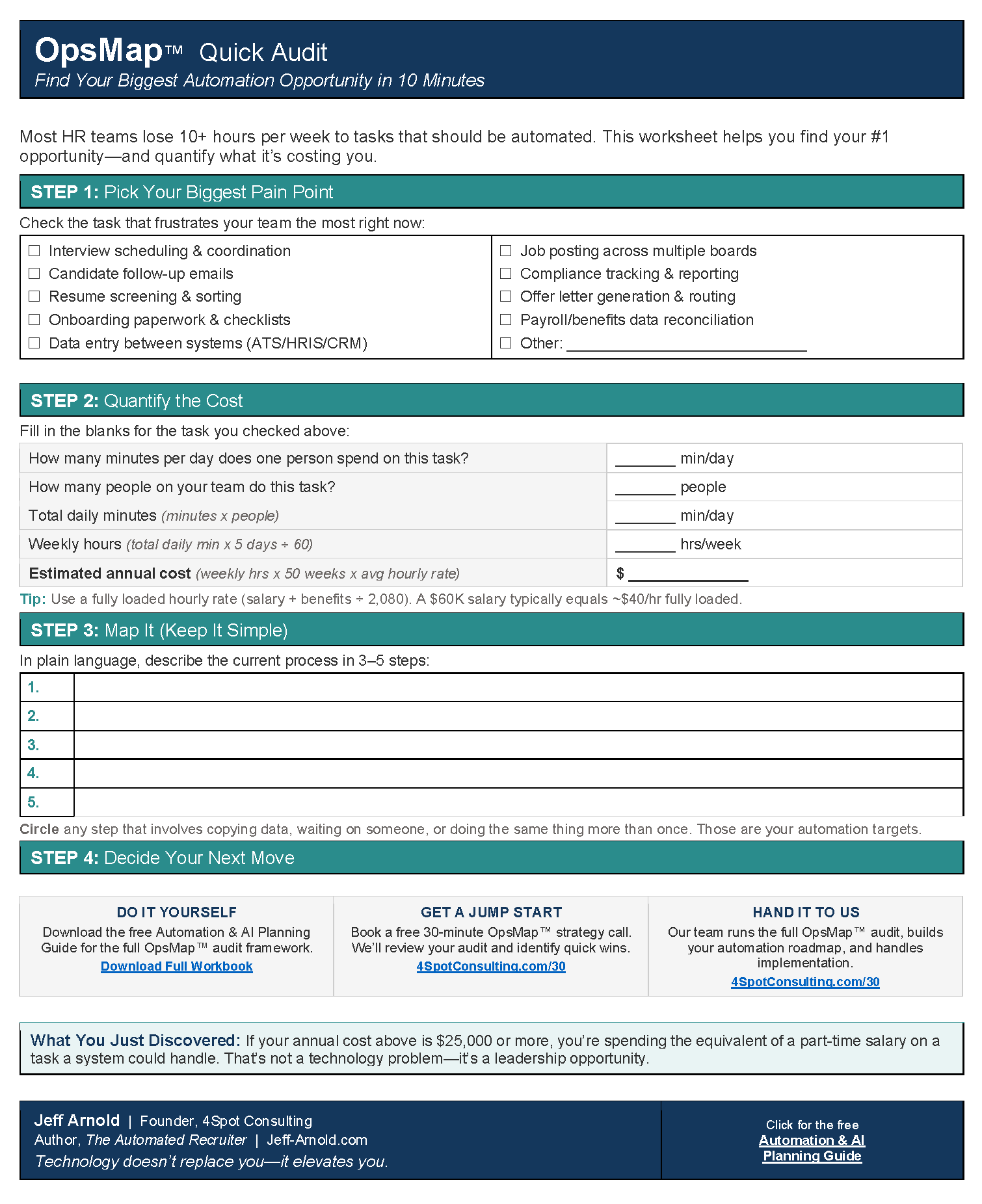
The first automation candidate passes a two-part filter: does the task occur at least once per day, and does it require zero human judgment to complete? Both must be true. If yes to both, it is an OpsSprint™ candidate — a quick-win automation that proves value before full build commitment.
Apply the filter explicitly. Go through a week of your HR team’s activities. Mark every task that occurs daily or more frequently. From that list, mark every task where the correct action is always the same given the same inputs — no exceptions, no edge cases that require someone to think. The intersection is your first automation target list. Rank by hours consumed per week. The highest-hours task on the intersection list is your first build.
Common first candidates from HR operations: new application acknowledgment emails (triggered by ATS status change, always the same template, always immediate), interview reminder sequences (triggered by calendar event creation, always 24 hours and 1 hour before), offer letter document generation (triggered by offer approval, always using the same template fields), and new hire system provisioning requests (triggered by HRIS record creation, always routing to IT with the same field set).
Tasks that fail the filter — and should not be automated — include compensation band decisions, performance rating assessments, promotion evaluations, and any hiring decision that weighs qualitative candidate attributes. These tasks require human judgment and context that no deterministic rule captures. Thirteen essential questions for HR leaders before investing in automation maps the boundary between automatable and judgment-dependent work in detail.
The OpsSprint™ format is designed for exactly this category of first automation. It is a short-cycle build — two to four weeks from scoping to go-live — on a single, well-defined automation opportunity. The goal is a working automation in production, a measurable outcome, and a proof point that the leadership team sees before committing to a broader build program.
How Do You Choose the Right Make vs. Zapier for HR Automation Approach for Your Operation?
The choice comes down to three operational patterns: linear trigger-action processes, multi-branch conditional workflows, and AI-augmented judgment pipelines. Each has a platform and a methodology fit.
Linear trigger-action processes — single trigger, sequential actions, no branching — fit Zapier’s architecture. New application submitted, acknowledge email, ATS status updated, recruiter notified. That is a three-action linear sequence. Zapier builds it cleanly, maintains it simply, and runs it reliably. Choosing Make for this pattern adds architectural complexity without adding value.
Multi-branch conditional workflows — single trigger, multiple downstream paths determined by data values — fit Make’s architecture. Offer approval received, route to salary band review if above grade ceiling, route to standard HRIS creation if within band, route to executive approval if VP-level or above. That is a three-branch router. Make builds it in a single scenario. Zapier requires three separate Zaps with shared trigger conditions — a maintenance burden that compounds with every new branch added. Why advanced users outgrow Zapier for complex automation covers this architectural transition in full.
Build vs. Buy vs. Integrate is a separate but related decision. Build (custom from scratch using an automation platform) is right when no off-the-shelf solution matches your specific workflow. Buy (all-in-one HR platform with automation built in) is right when your processes are standard and the platform’s native automation is sufficient. Integrate (connect best-of-breed systems via an automation layer) is right when you have invested in specialized tools — a best-in-class ATS, a separate HRIS, a dedicated payroll system — that need to share data reliably. Most mid-market HR operations land in the Integrate category, which is where Make and Zapier deliver the most value. Ten critical questions for choosing your HR automation platform walks through this decision framework in full.
How Do You Implement Make vs. Zapier for HR Automation Step by Step?
Every HR automation implementation follows the same structural sequence regardless of platform. Skipping steps in this sequence is how projects produce automations that break in production, corrupt data, or generate compliance exposure.
Step 1: Back up first. Export the current state of every system the automation will touch. Store the backup in a location not affected by the automation run. Do not proceed until you have a verified backup.
Step 2: Audit the current data landscape. Review the quality, completeness, and consistency of the data in the source system. Identify missing values, inconsistent formats, and duplicate records. Clean the data before building — not after. The 1-10-100 rule applies here: the cost of a data error compounds at each stage downstream from where it originates.
Step 3: Map source-to-target fields. Document which field in the source system maps to which field in the destination system. Note data type conversions required (text to date, string to integer), character limits, required fields, and validation rules in the destination. This mapping document is also the foundation of the audit log design. Architecting your strategic HR automation engine covers the integration layer decisions that the field mapping stage drives.
Step 4: Build the pipeline with logging baked in. Wire the change log at the same time as the automation logic — not as an afterthought. The log captures record ID, before state, after state, and timestamp for every record the automation touches.
Step 5: Pilot on a representative record set. Run the automation on 5-10% of real records in a staging environment or against a test account. Review the output manually. Verify that every field mapped correctly, every conditional branch fired as designed, and the log captured every change. Correct errors before the full run.
Step 6: Execute the full run. Run the automation against the full record set. Monitor in real time during the first full run. Have the backup accessible if a rollback is needed.
Step 7: Wire the ongoing sync with audit trail. After the initial migration or build, configure the ongoing automation with the sent-to/sent-from audit trail between systems. The ongoing sync is a different automation from the migration — design it separately with its own logging and error handling.
How Do You Make the Business Case for Make vs. Zapier for HR Automation?
Lead with hours recovered for the HR audience. Pivot to cost impact and errors avoided for the CFO audience. Close with both. A business case that speaks only to hours does not survive the CFO’s desk. A business case that speaks only to hard savings does not resonate with the HR team that has to champion it internally.
Track three baseline metrics before building anything: hours spent on the target task per role per week, errors caught in that workflow per quarter, and time-to-fill or time-to-onboard compared to industry benchmarks. SHRM publishes benchmark data for time-to-fill across industries and organization sizes. APQC publishes HR process performance benchmarks that provide comparison points for administrative task burden. These external benchmarks give the business case credibility beyond internal estimates.
Cost impact calculation: hours recovered per week multiplied by the fully-loaded hourly cost of the HR role, annualized. For the scheduling automation example above — 6 hours per week recovered at a fully-loaded HR Director rate — the annualized return is material before the first line of automation logic is built. Add the errors-avoided savings using the 1-10-100 framework to estimate the cost of data errors the automation prevents, and the ROI case becomes difficult to argue against.
Parseur’s Manual Data Entry Report finds that a significant percentage of organizations cite manual data entry as a primary source of operational errors — a finding that maps directly onto the HR automation ROI case. Every manual transcription step in an HR workflow is a documented error source that the business case quantifies and eliminates. For a broader case study on what that looks like at scale, the 103K annual labor hours Make.com automation case study shows the compounding effect across a full HR operation.
What Are the Common Objections to Make vs. Zapier for HR Automation and How Should You Think About Them?
Three objections appear in virtually every internal conversation about HR automation. Each has a defensible answer that holds up in an approval meeting.
“My team won’t adopt it.” Adoption-by-design means there is nothing for the team to adopt. The automation runs behind the process the team already uses. When a recruiter changes a candidate status in the ATS, the downstream notifications, record creation, and data transfers happen automatically. The recruiter does not interact with Make or Zapier — they interact with the ATS they already know. Adoption friction is zero when the automation is invisible to the user.
“We can’t afford it right now.” The OpsMap™ guarantee is the direct answer to this objection. The OpsMap™ audit identifies the highest-ROI automation opportunities with projected savings, timelines, and dependencies. If the audit does not identify at least 5x its cost in projected annual savings, the fee adjusts to maintain that ratio. The entry point is structured to be self-funding from the first finding.
“AI will replace my team.” The automation-spine-plus-AI-judgment-layer model amplifies what the team does — it does not substitute for the human decisions that require context. Automating interview scheduling does not replace the recruiter’s judgment about candidate fit. Automating ATS-to-HRIS data transfer does not replace the HR Director’s decision about compensation. The tasks that automation eliminates are the ones that consume time without producing judgment. Microsoft Work Trend Index data shows that workers who offload administrative burden to automation report higher engagement and more time on strategic work — the opposite of displacement.
Expert Take
The three objections I hear most often are: ‘My team won’t adopt it,’ ‘We can’t afford it right now,’ and ‘I’m worried AI will replace my people.’ The adoption objection dissolves when you realize that automation-by-design means there is nothing for the team to adopt — the workflow changes invisibly behind the process they already use. The affordability objection is addressed by the OpsMap™ guarantee: if the audit does not identify 5x its cost in savings, the fee adjusts. The replacement objection misreads the model — AI at the judgment layer amplifies what your team does, it does not substitute for the human decisions that require context.
What Does a Successful Make vs. Zapier for HR Automation Engagement Look Like in Practice?
A successful engagement starts with an OpsMap™ audit and ends with a running OpsBuild™ that the HR team uses without thinking about it. The middle is where the architecture decisions, the logging design, and the AI-layer placement get built correctly.
A 45-person recruiting firm with 12 active recruiters went through the OpsMap™ process and identified nine discrete automation opportunities across their ATS, HRIS, email communications, and invoice processing workflows. The highest-impact opportunity was the ATS-to-HRIS data transfer — a manual process consuming significant recruiter time and generating data discrepancies at a rate that created downstream billing errors. The second-highest was the candidate communication sequence — status updates, interview confirmations, and rejection notifications sent manually from individual recruiter inboxes with no consistency or tracking.
The OpsBuild™ implementation produced a return exceeding 200% ROI over 12 months. The automation spine was built first — data transfer, communication sequences, document generation. AI judgment layers were added at two specific points: candidate deduplication on inbound applications and job requisition field extraction from free-text descriptions. Both AI layers operated inside the automation pipeline at defined judgment points, not as general-purpose overlays.
For context on what outcomes look like at a larger scale, the Global Talent Solutions automation transformation case study shows the compounding effect of a full automation spine built in the right sequence. For HR analytics and reporting, architecting your strategic HR automation engine covers the reporting layer that sits on top of a functioning spine.
UC Irvine research led by Gloria Mark found that each interruption in a knowledge worker’s day requires significant recovery time before the original task is resumed at full cognitive engagement. In HR, the interruptions that automation eliminates — manual data transfers, status check emails, scheduling coordination — are exactly the category of task that fragments recruiter and HR director attention throughout the day. The recovered time is not just hours on a spreadsheet. It is cognitive capacity returned to strategic work.
What Are the Next Steps to Move From Reading to Building Make vs. Zapier for HR Automation?
The OpsMap™ is the entry point — not a platform trial, not an internal working group, not another vendor demo. The OpsMap™ is a structured strategic audit that identifies the highest-ROI automation opportunities in your specific HR operation, with timelines, dependencies, system compatibility analysis, and a management buy-in plan built in. It produces a deliverable — a prioritized roadmap — not a recommendation to buy more software.
The sequence from here: OpsMap™ to identify the top three automation opportunities, then OpsSprint™ on the highest-priority single automation, then measure the outcome, then OpsBuild™ on the full roadmap if the sprint validates the model. Each stage is a decision point. Nothing requires committing to the full build before seeing proof of value from the first sprint.
If the OpsMap™ does not identify at least 5x its cost in projected annual savings, the fee adjusts to maintain that ratio. The entry point is designed to be risk-free by construction. The question is not whether the ROI is there — McKinsey Global Institute research on automation in professional services consistently shows the opportunity in HR administration is substantial and consistent across organization sizes. The question is whether your organization captures it in the right sequence or wastes 18 months building in the wrong order.
For additional context on the platform decisions that underpin this work, 11 Make.com scenarios for strategic HR recruiting automation and the 10 critical questions for choosing your HR automation platform both round out the strategic picture. The architecture decision — Make or Zapier — resolves itself once the OpsMap™ has mapped the actual workflow logic. Linear processes get the right tool. Conditional multi-branch processes get the right tool. AI judgment layers get placed at the right points. That is the sequence that separates sustained ROI from expensive pilot failures.


RELATED POST

