207% ROI in 12 Months with Keap CRM Automation: How TalentEdge Transformed Their Candidate Journey

Most recruiting firms approach automation backwards. They deploy AI tools to score resumes and predict candidate fit — then wonder why the results are inconsistent and the ROI is invisible. TalentEdge made the opposite bet: build the automation spine first, then let AI earn its place. The result was $312,000 in annual savings and a 207% ROI within 12 months. This case study breaks down exactly how they did it, what it looked like inside Keap CRM, and what every recruiting leader should take from the sequence.

This satellite drills into the candidate journey automation layer of the broader Keap CRM recruiting automation guide — specifically how structured CRM sequences at each journey stage create the data foundation that makes everything downstream more reliable.


Snapshot: TalentEdge by the Numbers

Context Detail
Organization TalentEdge — 45-person recruiting firm
Team affected 12 recruiters managing active candidate pipelines
Constraint Manual candidate journey touchpoints consuming recruiter capacity across all pipeline stages
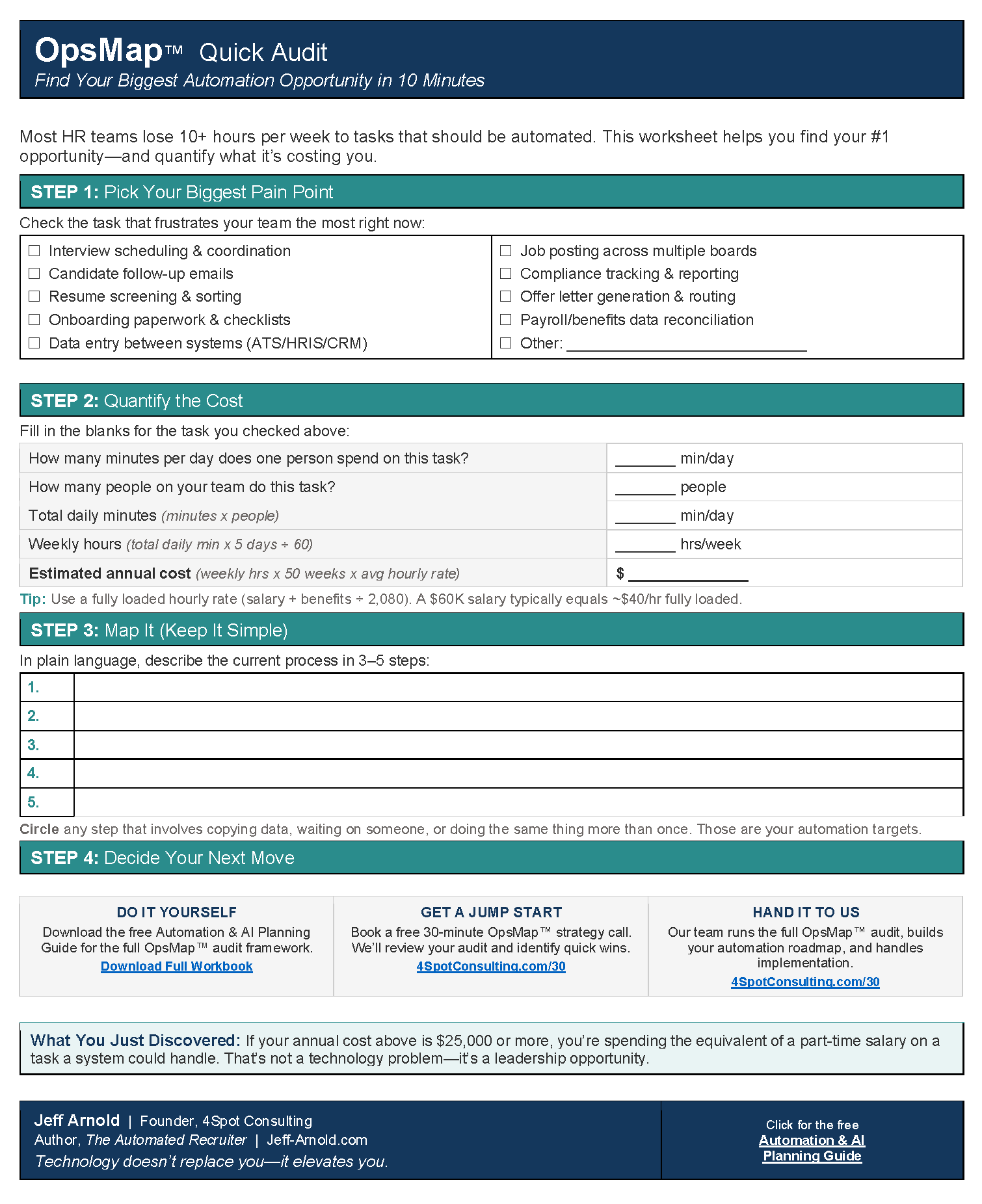
Approach OpsMap™ assessment → 9 automation opportunities identified → Keap CRM implementation
Annual savings $312,000
ROI at 12 months 207%
Key structural change Deterministic automation sequences built before any AI layer was introduced

Context and Baseline: What the Candidate Journey Looked Like Before

Before the OpsMap™ assessment, TalentEdge’s candidate journey was managed the way most recruiting firms manage it — through a combination of recruiter memory, shared spreadsheets, and manual email drafting. The process worked when pipeline volume was low. It broke as the firm scaled to 12 active recruiters managing concurrent searches.

The specific failure modes were predictable:

  • Inconsistent follow-up cadence. Candidates in late-stage evaluation received timely communication. Candidates in early pipeline stages — sourced but not yet active — received none. The silence read as disorganization to candidates and created re-sourcing costs when warm prospects went cold.
  • Manual scheduling coordination. Interview scheduling involved an average of 4–6 email exchanges per candidate before a time was confirmed. Across 12 recruiters each managing 15–25 active candidates, this generated hundreds of scheduling threads per week — all requiring recruiter attention and all interrupting deeper work.
  • Data entry without verification. Candidate status updates were logged manually into the firm’s systems after each interaction. The lag between interaction and logging created data gaps. By the time a recruiter pulled a candidate record to prep for a call, the last-updated date was often 5–10 days stale.
  • Re-engagement performed from memory. Passive candidates — those who had expressed interest but weren’t active — received re-engagement outreach only when a recruiter happened to remember them. There was no structured nurture sequence. Gartner research confirms that most organizations lose qualified pipeline candidates to competitors not because the candidates withdrew, but because the firm stopped communicating first.

Parseur’s Manual Data Entry Report places the annual cost of manual data-entry workflows at $28,500 per employee. Across 12 recruiters, the math suggested TalentEdge was absorbing over $340,000 per year in manual-process friction before accounting for the downstream cost of placements lost to slow response cycles.


Approach: The OpsMap™ Assessment and What It Found

The OpsMap™ assessment mapped every step of TalentEdge’s candidate journey — from initial sourcing touchpoint through placement and post-placement check-in — and categorized each step by two variables: how much recruiter time it consumed, and whether it required human judgment or could be handled by a deterministic rule.

Nine automation opportunities cleared both thresholds: high time consumption, no genuine judgment required. They fell into three categories:

Category 1: Intake and Acknowledgment (3 Opportunities)

  • Automated application acknowledgment sequences firing within minutes of form submission
  • Tag-triggered intake questionnaires sent to candidates who reached specific pipeline stages
  • Document collection reminders for candidates who had not submitted required materials within 48 hours

Category 2: Scheduling and Coordination (3 Opportunities)

  • Self-service interview booking links embedded in stage-transition emails, eliminating the back-and-forth scheduling thread
  • Automated confirmation and reminder sequences sent to both candidates and hiring managers 48 hours and 2 hours before each scheduled interview
  • Post-interview follow-up sequences triggered automatically when a candidate’s pipeline tag advanced past the interview stage

Category 3: Nurture and Re-Engagement (3 Opportunities)

  • Passive candidate nurture sequences — segmented by role category and skills profile — delivering relevant content on a structured cadence without recruiter intervention
  • Re-engagement sequences triggered when a candidate had been static in a pipeline stage for more than 14 days without a logged interaction
  • Post-placement check-in sequences at 30 and 90 days, maintaining the relationship without requiring recruiters to manually track placement anniversaries

All nine were implemented inside Keap CRM using tag-based triggers, custom pipeline stages, and sequence automation. None required AI. All nine were deterministic: if condition A was met, action B fired. Understanding how to segment your talent pool in Keap CRM was the prerequisite that made categories 2 and 3 possible — without clean segmentation, the nurture sequences would have been generic and ineffective.


Implementation: Building the Automation Spine in Keap CRM

The implementation followed a deliberate sequence that most firms skip: data architecture before automation build.

Phase 1 — Tag Architecture and Pipeline Stage Design (Weeks 1–2)

Before a single automation sequence was written, TalentEdge’s Keap CRM instance was structured to support clean data. This meant designing a tag taxonomy that reflected the candidate journey — not just job titles and skills, but journey-stage tags that would serve as automation triggers. Every tag served a dual purpose: it described the candidate’s status and it triggered or suppressed specific sequences. See the detailed approach to advanced Keap CRM tags and custom fields for candidate profiling for the structural logic behind this layer.

Pipeline stages were mapped to mirror the actual candidate journey, not an idealized version of it. The distinction matters: many implementations build pipeline stages that reflect what firms wish candidates did, then wonder why stage progression data doesn’t match reality. TalentEdge’s stages were built from 60 days of historical data on how candidates actually moved through their process.

Phase 2 — Sequence Build and Logic Testing (Weeks 3–5)

Each of the nine automation opportunities was translated into a Keap CRM sequence with:

  • A defined trigger condition (tag applied, stage advanced, time elapsed without interaction)
  • A defined action chain (email sent, task created, tag updated, recruiter notified)
  • A defined suppression condition (candidate already in a later stage, opted out, or flagged as inactive)

Suppression conditions are where most automation builds fail. Without them, sequences fire at the wrong candidates at the wrong time, producing a candidate experience that feels automated rather than personalized. Every sequence was tested against edge cases before it touched a live candidate record. The implementation approach described in the Keap CRM implementation checklist for recruitment covers the testing protocol that prevents these failure modes.

Phase 3 — Recruiter Enablement and Adoption (Weeks 6–8)

The sequences were live before any recruiter training began. This sequencing was intentional. Recruiters who see automation working — candidates receiving timely follow-ups without recruiter action, scheduling threads disappearing — adopt the system faster than those who are trained on a system they haven’t yet experienced. Asana’s Anatomy of Work research identifies adoption friction as the primary reason automation investments fail to sustain their initial gains. TalentEdge avoided this by letting the sequences prove their value before making adoption a requirement. For teams experiencing adoption resistance, the Keap CRM implementation challenge guide addresses the most common friction points by role.


Results: What Changed at 30, 90, and 365 Days

30-Day Mark

Scheduling-related email volume dropped by more than half across the 12-recruiter team. Recruiters reported the first meaningful reduction in daily context-switching — consistent with UC Irvine research by Gloria Mark, which places the average focus-recovery time after an interruption at 23 minutes. Eliminating scheduling threads removed a category of interruption entirely, not just the minutes each thread consumed.

90-Day Mark

Passive candidate pipeline volume — candidates in active nurture sequences — grew by a measurable percentage as re-engagement sequences surfaced candidates who had been dormant in the database. Recruiters began reporting placements sourced from candidates who had been in the system for 6–18 months but had never received structured outreach. Harvard Business Review research consistently links proactive candidate communication to higher pipeline conversion rates; TalentEdge’s 90-day data validated this at the firm level.

12-Month Mark

Total annual savings: $312,000. ROI: 207%. The savings came from three sources: recruiter time recovered from manual touchpoints, reduced re-sourcing costs from improved passive candidate retention, and faster time-to-fill on active searches driven by the scheduling and coordination automations. McKinsey Global Institute research on workflow automation confirms that the highest-ROI automation implementations are those that stack multiple small-efficiency wins across a consistent process — not single large-process overhauls. TalentEdge’s nine-opportunity model is a direct example of this pattern.


Lessons Learned: What We Would Do Differently

Transparency about what didn’t go perfectly is more useful than a clean success narrative. Three things TalentEdge’s implementation revealed that inform how this work gets done now:

1. The Tag Audit Should Happen Earlier

TalentEdge’s existing Keap CRM instance had 200+ tags applied inconsistently over two years of use. The Week 1–2 tag architecture phase took longer than projected because auditing and retiring legacy tags was more complex than anticipated. Firms that begin an OpsMap™ engagement with a clean CRM instance save 1–2 weeks of implementation time. If your tag structure is already inconsistent, address it before building any automation — not alongside it.

2. Sequence Suppression Logic Requires More Upfront Attention Than Sequence Content

The content inside an automation sequence — the email copy, the subject lines — is easy to iterate. The suppression logic that determines when a sequence should not fire is harder to fix retroactively. Two of TalentEdge’s nine sequences fired at candidates who should have been suppressed during the first week of live operation. The errors were caught quickly and corrected, but they reinforced a principle: more time on suppression logic at build, less time on remediation post-launch. The personalized candidate journey methodology addresses how suppression logic serves personalization, not just error prevention.

3. AI Is Not the Next Step — Structured Data Is

At the 12-month mark, TalentEdge had a Keap CRM instance with 12 months of clean, structured candidate journey data: consistent tags, logged stage progressions, complete interaction histories. That data is now the asset that makes AI worth deploying — for candidate scoring, for engagement prediction, for sourcing prioritization. Firms that deploy AI on top of inconsistent CRM data get inconsistent AI outputs. TalentEdge’s sequence — automation first, data quality second, AI third — is the model. The AI and Keap CRM talent acquisition guide details where AI earns its place in a mature automation environment.


The Broader Pattern: Why the Candidate Journey Is the Right Place to Start

Forrester research on workflow automation ROI consistently finds that the highest-returning automation investments target processes that are both high-frequency and cross-functional — meaning they create value not just for the person executing them but for the person on the receiving end. The candidate journey is exactly this: every automated touchpoint saves recruiter time and simultaneously improves candidate experience.

Gartner’s talent management research identifies candidate communication consistency as one of the top three drivers of offer acceptance rate — ahead of compensation transparency and ahead of interview experience quality. An automated candidate journey, built correctly in Keap CRM, addresses the top driver directly. The distinction between a CRM-managed journey and an ATS-managed process is explored in depth in the Keap CRM vs. ATS comparison — the short version is that ATS platforms track compliance; CRM platforms build relationships.

SHRM data on unfilled position costs places the daily cost of a vacant role at meaningful fractions of annual salary. When automation compresses time-to-fill — by keeping candidates engaged, by accelerating scheduling, by maintaining passive pipeline readiness — the savings compound beyond the direct operational efficiency gains. TalentEdge’s $312,000 figure reflects both the direct and indirect value of automating a journey that previously leaked value at every manual stage.


Closing: The Sequence That Produced the Result

TalentEdge’s 207% ROI was not accidental and it was not attributable to a single tool or a single workflow. It came from a sequence: audit the candidate journey, identify the deterministic touchpoints, build automation that fires without recruiter intervention, create the data quality that makes everything downstream reliable. The result was a recruiting firm that could scale pipeline volume without scaling headcount — and a candidate experience that communicated professionalism at every stage, automatically.

For recruiting firms evaluating where to begin, the OpsMap™ assessment is the starting point — not because it is a prerequisite, but because it produces a prioritized roadmap rather than a guess. The recruitment funnel automation guide covers how the journey from cold candidate to placed hire can be automated end-to-end once the foundational sequences are in place.