

Post: Webhooks vs. Mailhooks for HR Automation in Make.com (2026): Which Is Better for Your Workflows?
Webhooks vs. Mailhooks for HR Automation in Make.com (2026): Which Is Better for Your Workflows?
The trigger layer is the foundation of every automation. Get it wrong and every downstream process — routing, data writes, compliance logging, AI enrichment — operates on an unreliable or delayed foundation. In Make.com™, that trigger decision comes down to webhooks or mailhooks, and for most HR workflows, the answer is not a coin flip. This satellite drills into the strategic comparison so you can choose the right trigger architecture before you build a single scenario. For the full strategic context, start with our guide on mastering HR automation in Make.com™ with webhooks and mailhooks.
Quick Comparison: Webhooks vs. Mailhooks at a Glance
Webhooks win on speed, data integrity, and audit reliability. Mailhooks win on accessibility and legacy system compatibility. Here is the side-by-side breakdown before we go deeper on each decision factor.
| Factor | Webhooks | Mailhooks |
|---|---|---|
| Trigger latency | Near-zero (milliseconds) | Variable (seconds to minutes) |
| Data structure | Typed JSON — consistent, predictable | Free-text email body — requires parsing |
| Setup complexity | Requires source app API access | Email address only — no API needed |
| Scalability | High — no inbox bottleneck | Limited — inbox volume is a constraint |
| Audit reliability | Deterministic, timestamped payloads | Email thread dependent, variable |
| Legacy system support | Requires modern API capability | Works with any system that sends email |
| Error handling | Retry logic, delivery confirmation | Dependent on email server reliability |
| Best HR use case | ATS sync, onboarding initiation, compliance alerts | Benefits vendor updates, legacy HRIS, email approvals |
Decision Factor 1: Trigger Latency
Webhooks win on latency — it is not close. For HR workflows where timing matters, webhooks are the only defensible choice.
A webhook fires the moment the source event completes. A candidate submits an application, an employee updates a direct deposit form, a manager approves a promotion — the HTTP POST hits Make.com™ within milliseconds. The scenario begins executing before the user has closed the browser tab.
A mailhook depends on the entire email delivery stack: SMTP handshake, receiving server queue, spam-filter processing, and Make.com™’s own polling interval against the dedicated inbox. That chain introduces delays that range from seconds to several minutes under normal conditions — and longer when email servers are under load or filtering aggressively.
For time-critical HR actions — offer letter generation, background check initiation, compliance deadline alerts — that delay is a workflow liability. Asana’s Anatomy of Work research found that workers spend a significant portion of their day on coordination overhead; adding artificial latency to automated triggers compounds that problem rather than solving it.
Mini-verdict: If the workflow is time-sensitive, webhooks are mandatory. Mailhooks are acceptable only where the process is inherently asynchronous and a delay of minutes is operationally irrelevant.
→ See also: webhooks vs. polling for HR workflows in Make.com for a deeper latency analysis.
Decision Factor 2: Data Integrity and Payload Structure
Webhooks deliver typed, consistent payloads. Mailhooks require you to trust that a vendor’s email template never changes — and it will.
Webhook payloads arrive as structured JSON with named fields, typed values, and a predictable schema. Your Make.com™ scenario maps applicant.first_name to your HRIS field and it works the same way on the ten-thousandth trigger as on the first. There is no ambiguity about whether a number is a string, no whitespace trimming required, no regex to maintain.
Mailhooks require parsing logic. You extract data from email subject lines, body text, or structured attachments. That logic works perfectly until the upstream vendor updates their email template — changes the subject line format, reformats the body table, or adds a new footer. Template drift is inevitable, and when it breaks, it breaks silently: the scenario still fires, but the extracted data is wrong.
Parseur’s Manual Data Entry Report estimates the fully loaded cost of manual data entry and correction at roughly $28,500 per employee per year when accounting for error rates and remediation time. Mailhook parsing errors are a direct contributor to that cost in HR contexts — every mis-parsed field that reaches a downstream system (payroll, HRIS, benefits platform) requires manual identification and correction.
For an illustrative example of what structured data failures cost: when a mid-market manufacturing HR manager ran ATS-to-HRIS data through an email-based integration with parsing ambiguity, a field mismatch contributed to a $103K offer becoming $130K in payroll — a $27K error that ended with the employee leaving. Webhooks do not eliminate human error, but they remove the parsing layer where silent errors incubate.
→ See also: webhooks vs. mailhooks for HR document automation for payload handling in document workflows.
Mini-verdict: For any HR data that flows into payroll, benefits, or compliance systems, webhook payloads are structurally more reliable. Use mailhooks only where the email is the definitive source of record and the parsing logic is simple enough to maintain.
Decision Factor 3: Setup Complexity and Technical Barrier
Mailhooks are easier to set up. That accessibility is real and worth acknowledging — but it should not drive the architectural decision.
A mailhook requires a dedicated email address, a Make.com™ scenario connected to it, and filtering logic to identify the right incoming messages. Any HR administrator with Make.com™ access can configure this without developer involvement. The source system needs only the ability to send an email — a capability every platform, old or new, has.
A webhook requires the source application to support outbound HTTP POST events, access to that application’s settings or developer console to configure the endpoint URL, and a Make.com™ webhook URL to receive the payload. For modern ATS platforms, HRIS tools, and assessment systems, this configuration takes under ten minutes. For platforms that lack API webhook support entirely, it may not be possible.
The setup complexity argument for mailhooks is strongest in two scenarios: when the source system genuinely cannot emit HTTP events, and when the automation owner lacks API access to the source system. Outside those constraints, the setup investment for webhooks is a one-time cost that pays back immediately in data reliability.
Mini-verdict: Mailhooks win on setup speed. Webhooks win on every operational metric that follows. If your source system supports webhooks, prioritize them regardless of setup friction.
Decision Factor 4: Scalability for High-Volume HR Operations
Webhooks scale horizontally. Mailhooks introduce inbox throughput as a ceiling.
In high-volume recruiting periods — campus hiring seasons, rapid headcount expansion, mass onboarding events — an automation platform can receive hundreds or thousands of trigger events per day. Webhooks handle this load natively: each event fires its own HTTP POST, Make.com™ queues and processes them in parallel, and no single resource becomes a bottleneck.
Mailhooks route everything through an inbox. At high volume, email delivery sequencing, inbox processing order, and Make.com™’s polling frequency all become throughput constraints. Emails that arrive in rapid succession may not process in the order they were sent. For workflows where sequence matters — step-by-step onboarding task generation, sequential compliance checkpoints — inbox processing order creates race conditions that webhook architecture prevents entirely.
McKinsey Global Institute research on automation potential in knowledge work notes that the reliability of the data pipeline is as important as the automation logic itself. An automation built on a high-reliability trigger layer compounds its value at scale; one built on a fragile trigger layer compounds its failure modes.
→ See also: real-time HR alerts with Make.com™ webhooks for high-volume alert architecture.
Mini-verdict: For any HR operation expected to scale — high-volume recruiting, enterprise onboarding, company-wide compliance campaigns — build on webhooks from day one. Retrofitting the trigger layer after scale is painful.
Decision Factor 5: Error Handling and Operational Resilience
Webhooks give you more control over failure recovery. Mailhooks delegate resilience to email infrastructure you do not own.
When a webhook delivery fails — network timeout, Make.com™ scenario error, downstream system outage — the source application can retry the HTTP POST, Make.com™ can log the failed attempt, and your error handler can route the event to a fallback path or alert an administrator. The failure is visible, timestamped, and recoverable with clear audit evidence.
When a mailhook fails — spam filter intercepts the trigger email, email server delays delivery, Make.com™ inbox polling misses the message — the failure is often invisible until a downstream process is already broken. You may not know a trigger email was missed until a new hire’s onboarding tasks were never generated or a compliance deadline was never surfaced.
Gartner research on HR technology resilience consistently identifies data pipeline reliability as a top operational risk for HR automation programs. The error visibility gap between webhooks and mailhooks directly maps to that risk.
→ See also: troubleshooting Make.com™ webhook failures in HR automation for the full recovery playbook.
Mini-verdict: Webhooks provide structurally superior error handling. Mailhook resilience is largely dependent on factors outside your control — a risk that grows as automation becomes more critical to HR operations.
Decision Factor 6: Legacy System and Vendor Compatibility
Mailhooks are the right answer when the source system is the constraint — not when the team prefers the easier path.
Many HR ecosystems include legacy platforms — older HRIS tools, benefits administration systems, background check vendors, EAP providers — that predate modern API design. These systems send automated email notifications as their primary integration mechanism. Mailhooks are purpose-built for exactly this constraint: they turn an email notification into a structured automation trigger without requiring any change to the source system.
Third-party vendor workflows are another legitimate mailhook use case. When a background check vendor sends a completion email, when a benefits carrier sends an enrollment confirmation, when a payroll provider sends a processing report — if these vendors do not offer webhook endpoints, mailhooks are the correct bridge. The alternative is manual monitoring of those emails, which Asana’s Anatomy of Work data identifies as exactly the kind of low-value coordination work that automation should eliminate.
→ See also: how mailhooks work in Make.com™ for HR teams for implementation patterns.
Mini-verdict: Mailhooks are a legitimate and strategic tool for legacy and vendor-constrained workflows. That legitimacy is specific — it does not extend to using mailhooks as a default because webhook setup seemed complicated.
Choose Webhooks If… / Choose Mailhooks If…
Choose Webhooks If:
- Your source system (ATS, HRIS, assessment platform) supports outbound HTTP webhook events
- The workflow is time-sensitive — offer letters, compliance alerts, onboarding initiation, approval chains
- Data flowing into the automation will reach payroll, benefits, or compliance systems where field accuracy is non-negotiable
- You expect trigger volume to scale with headcount or hiring velocity
- You need a clear audit trail with timestamped, structured payload evidence
- The workflow sequence matters and out-of-order processing would create errors
Choose Mailhooks If:
- The source system genuinely cannot emit API events and email is the only integration path
- A third-party vendor sends email notifications as their only data delivery mechanism
- A human email reply is the intended trigger (e.g., manager approval via email reply)
- The workflow is batch-oriented and a processing delay of minutes is operationally irrelevant
- The automation owner lacks API access to the source system and webhook configuration is not feasible in the current engagement
The Hybrid Architecture: Using Both in the Same Stack
The most mature HR automation stacks in Make.com™ are not webhook-only or mailhook-only. They are hybrid: webhooks as the primary trigger spine for API-enabled systems, mailhooks as targeted bridges for legacy and vendor-constrained workflows, with both feeding into shared downstream logic — deduplication, routing, data normalization, HRIS writes.
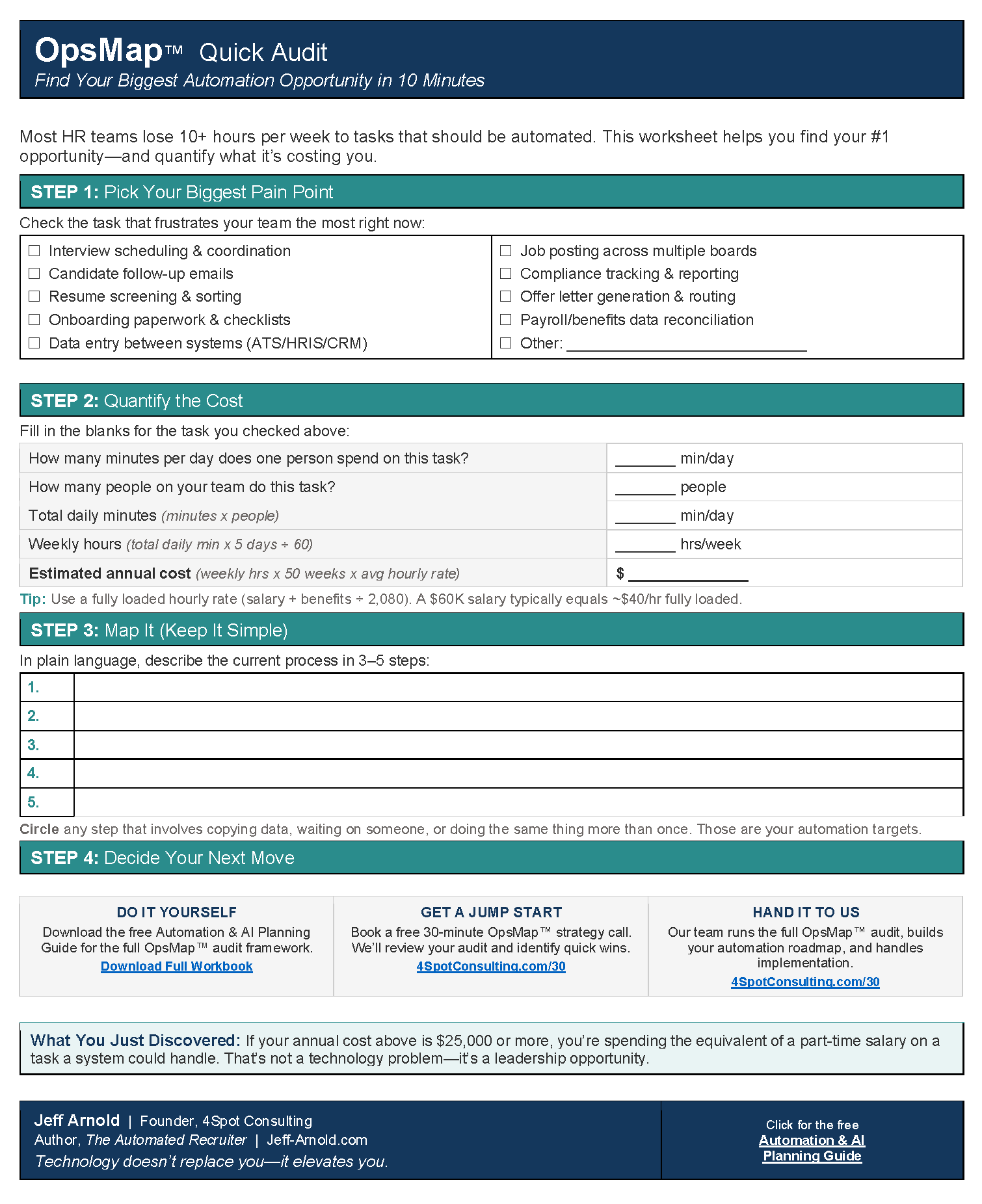
In our OpsMap™ engagements, we typically map HR automation opportunities into three categories: API-ready (webhook primary), email-native (mailhook appropriate), and neither (change the source system or build a custom integration). The distribution varies by organization, but most mid-market HR stacks have more webhook-ready touchpoints than teams realize — because teams default to email-based workarounds for systems they have not fully explored.
The SHRM data on cost-per-hire and Forrester’s research on automation ROI both point to the same conclusion: the efficiency gains from automation compound when the underlying architecture is reliable. A hybrid trigger architecture that routes each workflow through the right trigger type is the operational foundation for compounding returns.
Forrester research on automation programs consistently identifies trigger architecture reliability as a primary driver of long-term ROI. The teams that maximize automation returns are those that invested in getting the trigger layer right before layering on workflow logic and AI enrichment.
Final Verdict
Webhooks are the right default for HR automation in Make.com™. They fire instantly, deliver structured data, scale without inbox constraints, and provide audit-ready error visibility. Mailhooks are a legitimate and strategic tool — for legacy systems, vendor-constrained workflows, and email-native processes — but they are a targeted solution, not a general-purpose trigger.
The decision is an infrastructure choice, not a feature preference. Make it deliberately, before you build. Every scenario you construct on top of the wrong trigger type will eventually surface the mismatch in ways that are expensive to fix.
For the full strategic framework — including how to layer AI judgment on top of the right trigger spine — see our parent guide on mastering HR automation in Make.com™ with webhooks and mailhooks.
Ready to see what this looks like in practice? Explore automating employee feedback with Make.com™ webhooks for a real implementation walkthrough, or review webhook and mailhook strategies for candidate sourcing automation to apply these principles to your recruiting stack.


RELATED POST

