Will AI replace lawyers?
No. AI will not replace lawyers, but it will take over much of the routine work that lawyers and their staff now do by hand. That includes first-pass document review, intake summaries, deadline reminders, drafts from templates and client status updates. Judgment, advocacy, client counsel and professional accountability stay with licensed attorneys. A firm that pairs its attorneys with well-built automation and AI gets more done with the same team.
Key Takeaways
- AI takes over tasks that follow a pattern and run on text. It does not take over the practice of law.
- Judgment, advocacy and accountability stay with the licensed attorney.
- Put automation in first and add AI on top of it. AI built on scattered data gives scattered results.
- Confidentiality, accuracy and human review decide whether AI helps a firm or hurts it.
- What gets replaced is software and manual steps, not the lawyer.
What legal work can AI handle today?
AI handles work that follows a pattern and runs on text. In a law firm, that covers a long list of tasks:
- Reading intake forms and emails, then summarizing who the client is, what happened and what they want.
- Pulling dates, parties and amounts out of contracts, letters and court notices.
- Writing first drafts of routine letters, engagement documents and status updates from approved templates.
- Sorting incoming documents and sending each one to the right matter and the right person.
- Answering common client questions about where a matter stands, using information the firm already holds.
Today someone at the firm does each of these by hand. It might be a paralegal, an assistant or an attorney billing time on work below their rate. None of these tasks needs a law license, and every one of them takes time away from the work that does.
What stays with the lawyer?
Judgment, advocacy and accountability stay with the lawyer. AI can draft a motion. It cannot decide whether filing that motion serves the client, read a judge, negotiate across a table or give a client news they do not want to hear.
Legal advice also depends on context that never shows up in a document. That includes the client’s goals, how much risk they will accept, the history between the parties and what the other side is likely to do next. A model working only from text has none of that context. The attorney does.
Then there is responsibility. When a filing goes to a court or advice goes to a client, a licensed attorney stands behind it and answers for it. Software holds no license, and it does not answer to a client when something goes wrong.
Expert Take
People usually frame the replacement question as lawyers versus machines. That misses where an attorney’s time actually goes. In our work on law firm operations, the hours rarely go to legal analysis. They go to chasing documents, typing the same client details into three systems and answering emails that ask where a case stands. AI is no threat to the lawyer. It is a threat to the admin pile that keeps the lawyer from practicing law. Technology doesn’t replace people – it elevates them, and a law firm is one of the clearest places to see that.
How does AI change the way a law firm runs?
AI changes the operations around the lawyer, not the lawyer’s role. The biggest gains come when automation handles the structured steps first and AI then handles the unstructured text.
Automation moves data between the systems a firm already uses: the intake form, the practice management system, the calendar, document storage and billing. When a new matter opens, the client record, the folder, the conflict check request and the first deadlines are all created without anyone typing them twice. AI then reads what arrives as free text, such as an emailed question or a scanned notice, and turns it into fields the automation can act on.
The order matters. AI built on scattered data and undocumented steps gives scattered results. AI built on a mapped, automated process produces work an attorney can review quickly and trust.
The firm keeps the systems its people already know. That is the same principle behind our guide on how to supercharge an ATS with automation without replacing it: connect and extend what you have before you buy something new. Over time, the software layer is the part that changes fastest. Our guide The Death of the SaaS Moat explains why custom AI-built software is replacing the software stack businesses bought, and it reaches the same conclusion as this post: the tools get replaced, not the people who use them.
What should a law firm watch for when it adds AI?
Watch three things: client confidentiality, whether the AI’s output is accurate, and who reviews that output before it leaves the firm.
- Confidentiality. Client information is the most sensitive thing a firm holds. Before any AI tool touches it, the firm needs to know where the data goes, who can see it, how long it is kept and whether the vendor uses it to train models. Get those answers before the first document goes in.
- Accuracy. AI writes fluent text whether it is right or wrong. It can state a wrong date, misread a clause or cite authority that does not exist. Anything that goes to a client, a court or opposing counsel needs a person to check it against the source.
- Review and ownership. Decide ahead of time which outputs an attorney approves, which a paralegal checks and which can run on their own, such as internal reminders. Write it down so the process holds up when staff change.
This post explains how AI fits into a firm’s operations. It is not legal advice. Each firm should confirm its own professional obligations around technology with qualified counsel.
Common questions about AI and lawyers
How does AI change the work of paralegals and legal assistants?
AI takes over tasks, not roles. Data entry, document sorting and status updates are the first tasks automation and AI take over. Paralegals and assistants then spend more of their time on client contact, quality review and case support that needs a person’s judgment.
Can AI give legal advice to a firm’s clients?
No. AI can answer factual questions from information the firm has approved, such as the next hearing date or which documents are still missing. Advice on what a client should do comes from a licensed attorney, and the firm decides what any client-facing tool is allowed to say.
Will smaller firms fall behind larger ones?
Not if they build carefully. Smaller firms use the same automation platforms and AI models as larger firms, and a small team with fewer systems can connect them faster. The firms that fall behind are the ones that keep paying attorneys to do administrative work.
Why getting this right matters, and where help fits
Getting AI right protects the two things a law firm sells: its attorneys’ time and its clients’ trust. A tool that saves an hour but exposes client data or sends out a wrong deadline costs the firm far more than it saves.
That is why firms bring in help to design and build these systems instead of wiring tools together one at a time. The work starts by mapping how matters move through the firm today, where data gets entered twice and where people wait on each other. Then the automations are built in the right order, each AI step gets clear limits and a review point, and every step gets error handling so a failure shows up instead of going unnoticed.
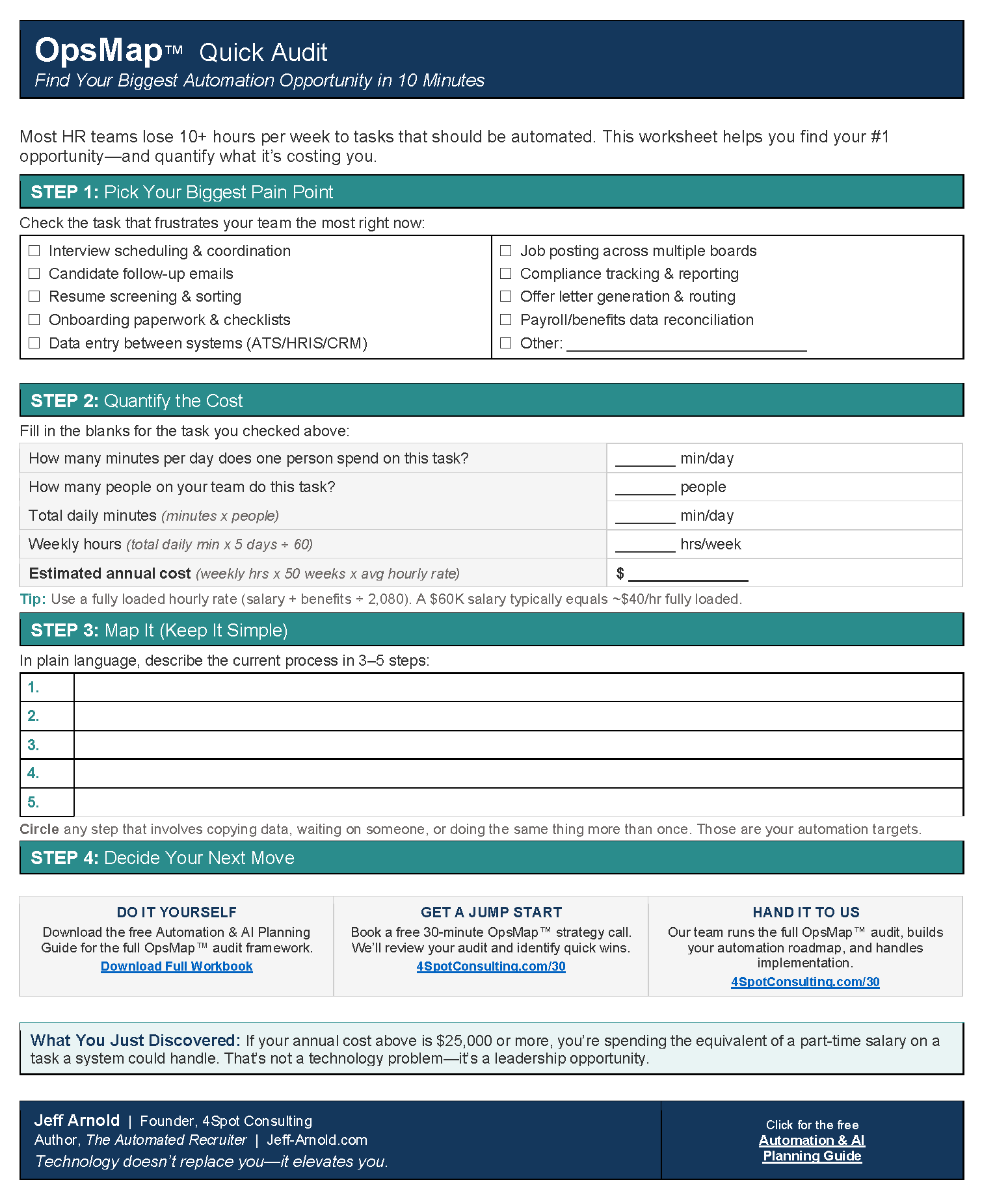
This is what 4Spot Consulting does. We design and build automation and AI done right on Make.com, connecting the systems a firm already uses. Our OpsMap™ process maps the current operation and sets priorities. OpsBuild™ then puts the automations and AI steps in place, with the review points attorneys need. The goal is to stop high-value people from doing low-value work.
Next steps
If you want your attorneys practicing law instead of chasing paperwork, contact 4Spot Consulting and let’s talk about where automation and AI fit in your firm.