Post: Why Clean Processes Must Come Before Any HR Automation
Clean processes must come before any HR automation because automation multiplies whatever you feed it. Automating a broken workflow produces broken results faster and at scale. Map, document, and fix each HR process first, then automate the version that already works. This order protects data, people, and trust across the entire employee lifecycle.
Every HR leader who has watched an automation backfire knows the pattern. The tool worked exactly as designed. The problem was the process underneath it. When you automate confusion, you get confusion at machine speed. This guide explains why process hygiene is the real prerequisite for HR automation, and how to sequence the work so the technology earns its keep.
The Case for Fixing Processes First
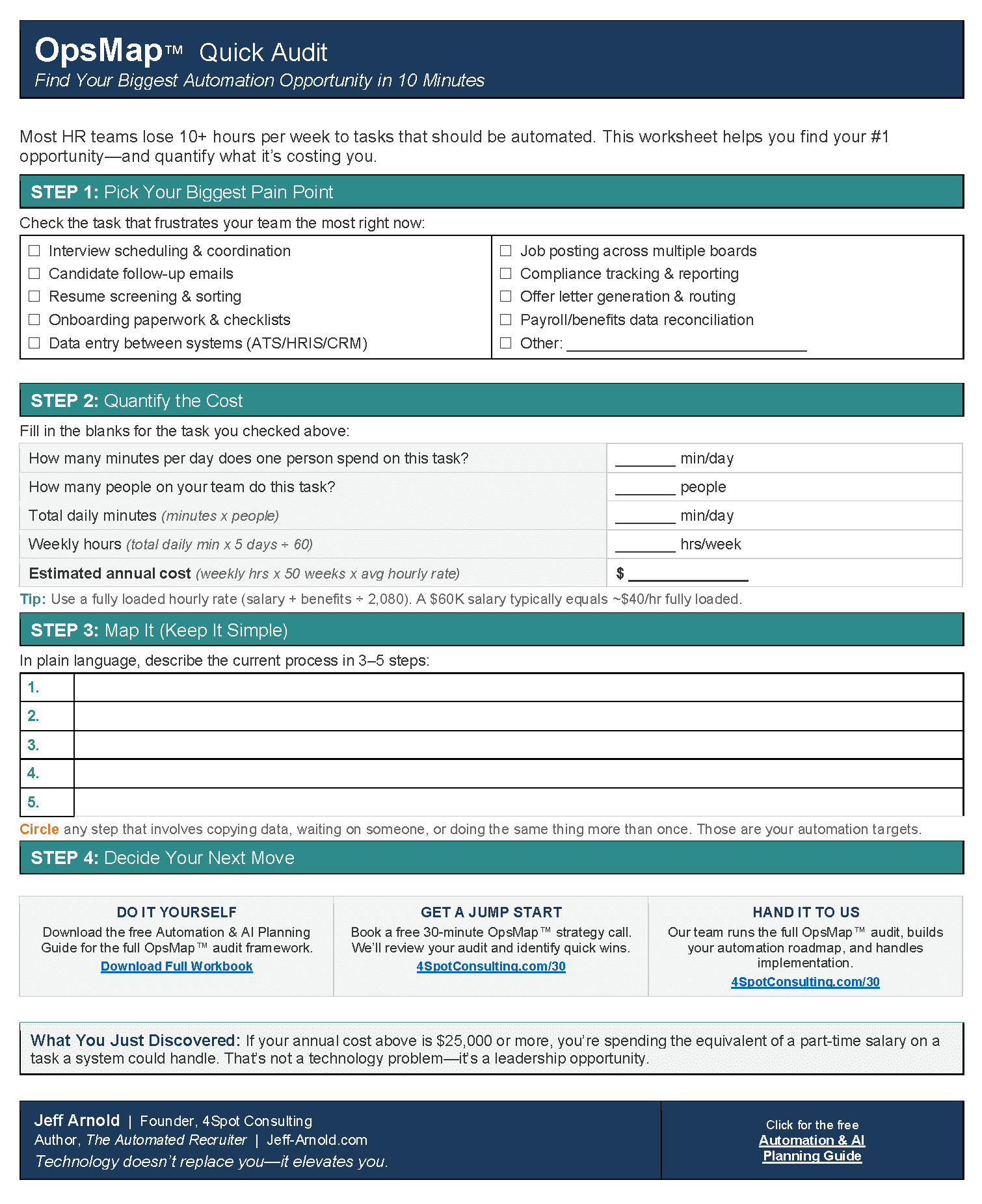
Automation is a force multiplier, and force multipliers amplify both strength and weakness. A clean process gives the software clear rules, predictable inputs, and a single source of truth. A messy process gives the software contradictions to enforce at scale. At 4Spot Consulting, our OpsMesh™ framework treats process cleanup as the first phase precisely because the cost of skipping it compounds with every record the system touches.
The argument is not anti-technology. It is pro-sequence. Order the work correctly and the same automation that would have spread errors instead removes them. We make the why behind clean processes first the center of every HR engagement, and we lay out the case for clean processes before automation for any leader weighing the trade. For skeptics, we offer an honest take on process-first HR automation, a push to rethink how HR teams approach automation, and a plain answer to why you should care about clean processes before automating.
What a “Clean Process” Actually Means
A clean process is one that is documented, repeatable, owned, and free of contradictions before a single trigger fires. It has a defined start, a defined end, named decision points, and one agreed-upon way to handle each exception. When a process meets that bar, automation becomes a transcription job rather than a guessing game.
Most HR teams have never written their processes down in this form, which is why the cleanup phase surprises people. Use these references to ground the vocabulary: what process-first HR automation is, what it means to clean a process before automating, and defining clean processes for HR automation. Newcomers should start with a plain-English guide to clean processes before automation and move to understanding why clean processes come first.
From there, build depth with the basics of clean processes before HR automation, clean processes before automation, explained, and what you need to know about clean processes first. Round it out with an introduction to process-first HR automation and a glossary of key terms in clean-process HR automation.
The Mistakes That Break HR Automation
The fastest way to waste an automation budget is to automate a process nobody fully understands. Teams skip the mapping step, hard-code an exception that was never standard, and then spend months untangling records the system mangled at scale. Knowing the failure patterns in advance is the cheapest insurance you will buy. Our OpsMap™ diagnostic exists to surface these gaps before any build begins, and the lessons line up with what we see in common mistakes HR teams make automating internally and critical pitfalls to avoid for successful HR automation.
Work through the full catalog of warning signs and missteps: 5 things to know about why clean processes come first, 7 common mistakes with process-first HR automation, 10 signs you need to clean processes first, 6 myths about clean processes and automation, and 8 best practices for clean processes before automating.
Keep going with 9 questions to ask about process-first HR automation, 5 steps to clean processes before automation, top 7 tools for clean-process HR automation, 12 stats that explain why clean processes come first, and 5 red flags in your current HR processes.
Finish the audit with 6 quick wins for clean processes before automating, 8 reasons to rethink your automation order, 10 real examples of process-first HR automation, 5 costly pitfalls in skipping process cleanup, and 7 trends shaping clean-process HR automation.
Expert Take
The teams that win with automation are not the ones with the biggest tech stack. They are the ones who refused to build until the process was boring. A boring process has no surprises, no undocumented exceptions, and no tribal knowledge locked in one person’s head. Boring is exactly what automation needs. Make the process boring first, and the software becomes the easy part.
How to Clean a Process Before You Automate It
Cleanup follows a strict order: map the current state, strip the exceptions that are not real standards, assign one owner, document the rules, and only then design the automation. Our OpsSprint™ phase runs this sequence in short, focused cycles so the work ships instead of stalling. Each step has its own depth, and the satellite guides below walk through them one at a time.
Start with the fundamentals: how to put clean processes before HR automation, a beginner’s guide to clean processes first, step by step process cleanup before automation, the complete guide to process-first HR automation, and how to get started with clean processes first.
Then handle selection and prevention: how to choose which processes to clean first, how to avoid mistakes in process-first automation, a practical guide to clean processes before automating, how to set up clean processes before automation, and how to evaluate a process for automation readiness.
Close the loop with execution and growth: how to implement clean processes before automation, how to measure clean-process results, how to troubleshoot a process before automating, how to scale clean processes across HR, and how to plan clean processes before HR automation. Leaders weighing readiness should also review the signs your HR team is ready for Make.com automation.
What This Looks Like in Practice
Real engagements prove the point better than theory does, so we document the before-and-after of each cleanup. Our OpsBuild™ phase only starts once the mapped process passes review, which means the case studies below all share one trait: the process was clean before the first module ran. The result is automation that holds up under load instead of buckling.
See the work in detail: a case study in process-first HR automation, how one team solved their process-first problem, real results with clean processes first, before and after clean-process automation, and a customer story on clean processes first.
Go deeper with lessons from process-first HR automation, inside a successful clean-process rollout, what we learned from cleaning processes first, a real-world example of process-first automation, and how a small business tackled clean processes first.
And review the walkthroughs: from problem to solution in HR automation, a walkthrough of clean processes before automating, behind the scenes of a clean-process build, how we approached process-first HR automation, and a closer look at clean processes first. For a longer field guide, read the leader’s guide to flawless HR automation implementation.
Choosing Your Approach
Two HR teams with the same goal will land on different cleanup paths depending on size, risk tolerance, and existing tooling. The right call comes from comparing options against your real constraints, not from copying someone else’s stack. Our OpsCare™ phase keeps the comparison honest after launch by tracking whether the chosen approach still fits as the team grows. The decision guides below frame those trade-offs.
Weigh the options: comparing approaches to process-first automation, the pros and cons of cleaning processes first, which option fits your needs for HR automation, the tradeoffs in process-first HR automation, and build vs buy for clean-process automation.
Compare the models side by side: in-house vs outsourced process cleanup, manual vs automated HR processes, choosing the right approach to clean processes first, a side by side look at clean-process options, and the smarter choice for process-first HR automation. Before you commit budget, work through the essential questions HR leaders ask before investing in automation.
Frequently Asked Questions
Why can’t I just automate and fix the process later?
Fixing later costs more than fixing first because automation locks the bad logic into every downstream system and record. Once the software has propagated an error across hundreds of employee files, you pay twice: once to unwind the damage and again to rebuild the process you should have cleaned at the start. Read more in the FAQ on clean processes before HR automation.
How do I know if my process is clean enough to automate?
A process is ready when it is documented, has one owner, handles every known exception the same way, and produces the same output regardless of who runs it. If two people on your team describe the steps differently, the process is not clean yet. We answer common questions about clean processes first and answers to your questions on process-first automation in more depth.
Does process cleanup slow down my automation rollout?
Cleanup shortens the total timeline because it removes the rework that broken automation forces. The mapping phase feels slower in week one and pays back many times over once the build runs without rebuilds and rollbacks. See frequently asked questions on clean processes first for the full breakdown.
Where should an HR team start?
Start with the one process that causes the most pain and the most manual rework, then map it end to end before touching any tool. That single clean process becomes the template for every automation that follows. Get the short version in quick answers about clean processes before automating.
The Bottom Line
Clean processes are the foundation that makes HR automation pay off instead of backfire. Sequence the work right, map and fix before you build, and the technology stops being a risk and starts being leverage. 4Spot Consulting runs this order on every engagement so the automation you invest in holds up under real-world load. Keep Automating.